

This Month
Music Revival Concert in KwaZulu-Natal with Steinway pianist Christopher Duigan presented on Pietermaritzburg, Amber Valley, Howick, Kloof and beyond. Based at Casa Mexicana.
This Month
Music Revival Concert in KwaZulu-Natal with Steinway pianist Christopher Duigan presented on Pietermaritzburg, Amber Valley, Howick, Kloof and beyond. Based at Casa Mexicana.
‘Jewels, Gems and Masterpieces’
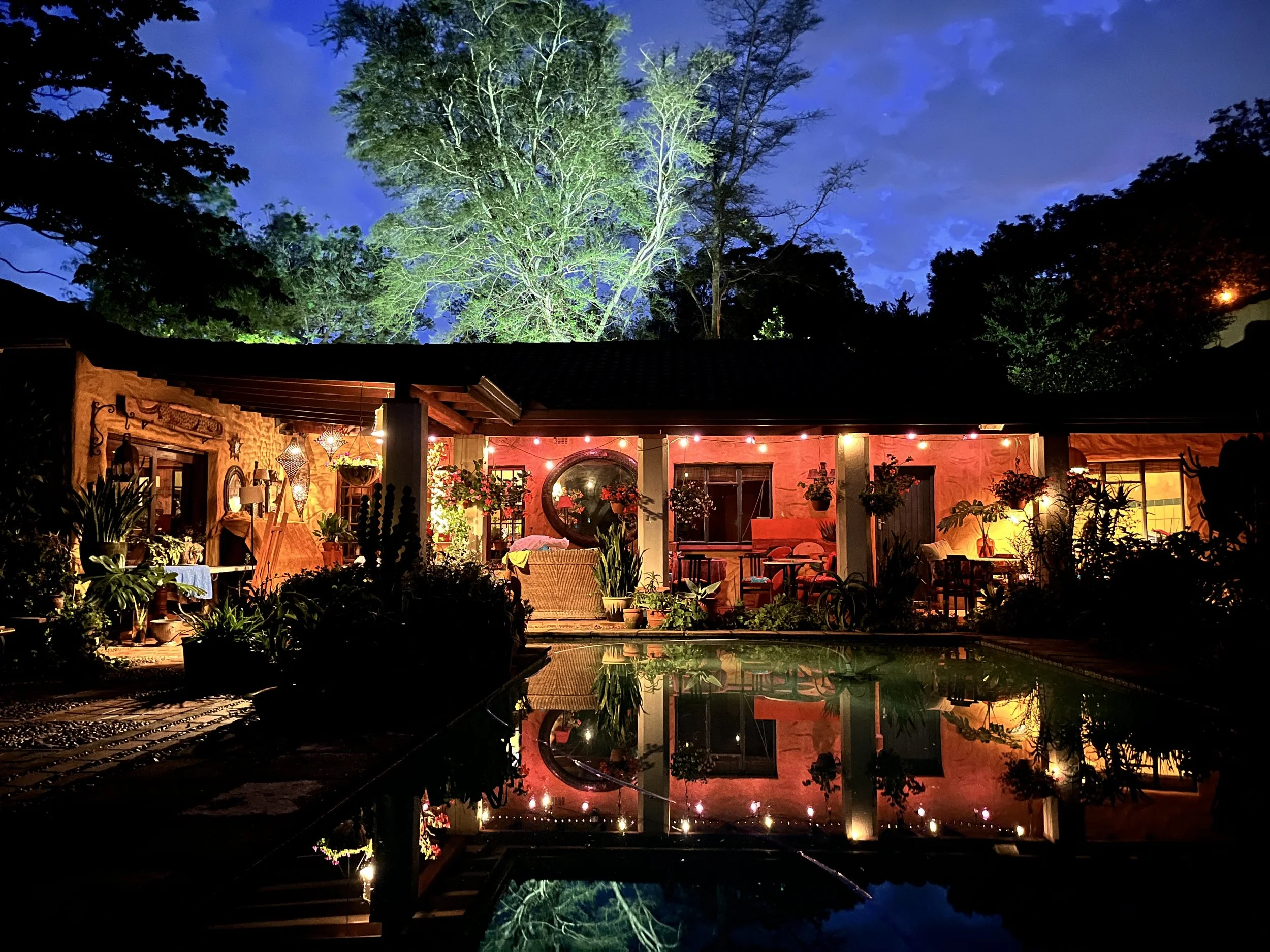
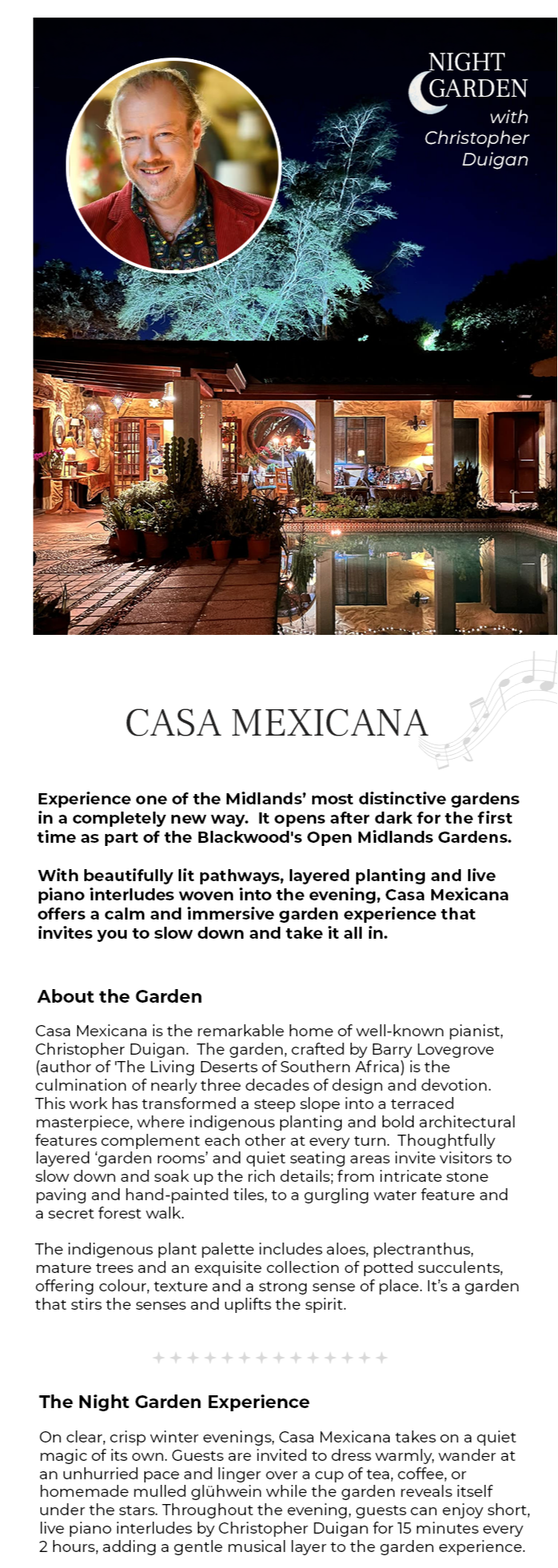
We have a superb evening lined up for this Friday. In addition to a delightful selection of music, there will be a classic minestrone enhanced with gremolata and pea pesto, served alongside crusty ciabatta and a variety of other artisanal breads, followed by a zesty lemon posset for dessert. Coffee and a selection of nougat will also be available to round off the evening. The garden is looking neatly trimmed after last week’s Open Gardens session and will be fully lit to create a welcoming atmosphere. There is also a new selection of artwork by Corina Lemmer, Jinny Heath and Hussein Salim to admire — and to purchase if you wish. Plus a fire in the kitchen if you are looking for a warm spot!
All bookings must be finalised by Friday 12 noon please.
Friday 5 JUNE 7:00 pm
CASA MEXICANA 35 Montgomery Drive, Pietermaritzburg
Tickets: R300 concert and dinner after or R150 concert only.
Venue opens at 6:30 pm. Performance time approx 60 mins at 7:00 pm.
Secure patrolled parking. Bring your own wine.
BOOKING IS ESSENTIAL : Book via WhatsApp 083 417 4473 or booking@musicrevival.co.za.
Please include your contact numbers in all e-mail bookings.
‘Jewels, Gems and Masterpieces’ unites beloved classics with lesser-known, often complex treasures from the piano repertoire.
Our June Concert
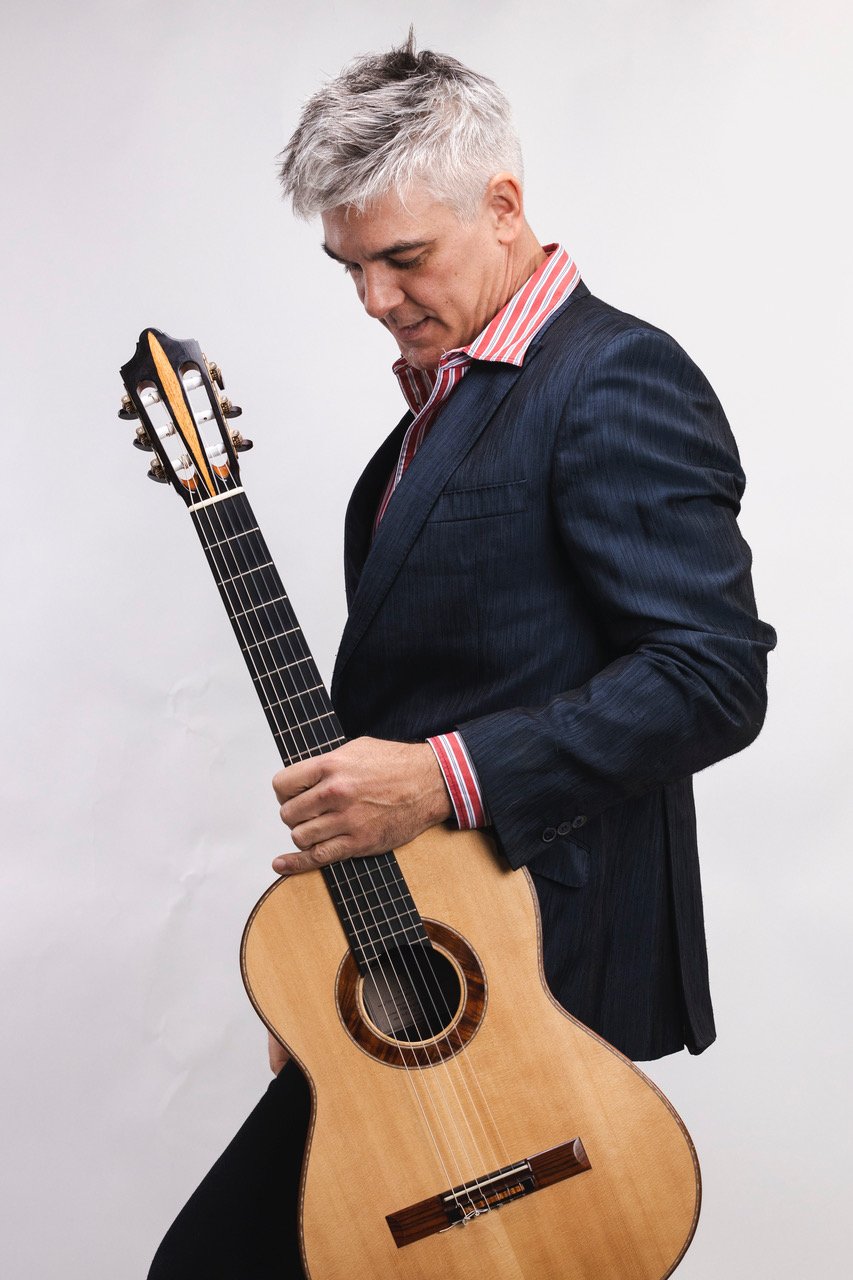
We are thrilled to announce that James Grace will be visiting to perform at the end of June. Please take careful note of the dates.
Tuesday 23 June 7:00 pm St Agnes, Kloof
Thursday 25 June 3:30 pm Woodgrove
Thursday 25 June 7:00 pm Amber Valley
Friday 26 June 7:00 pm Casa Mexicana
Monday 29 June 3:00 pm Amberfield
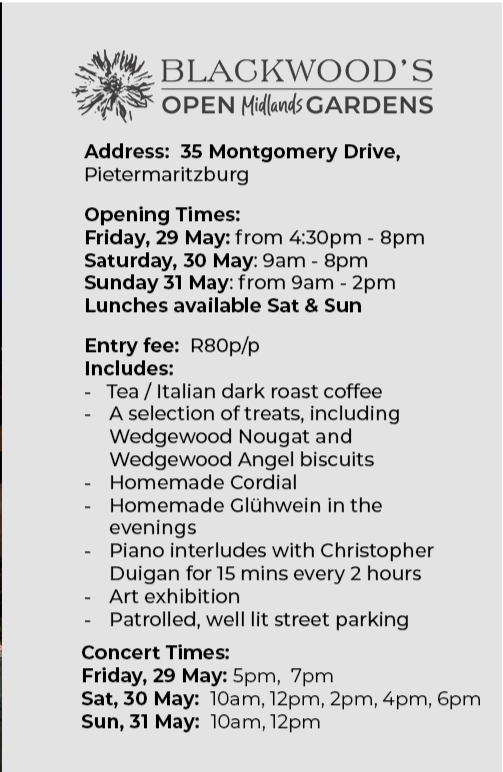
OUR MAY CONCERT
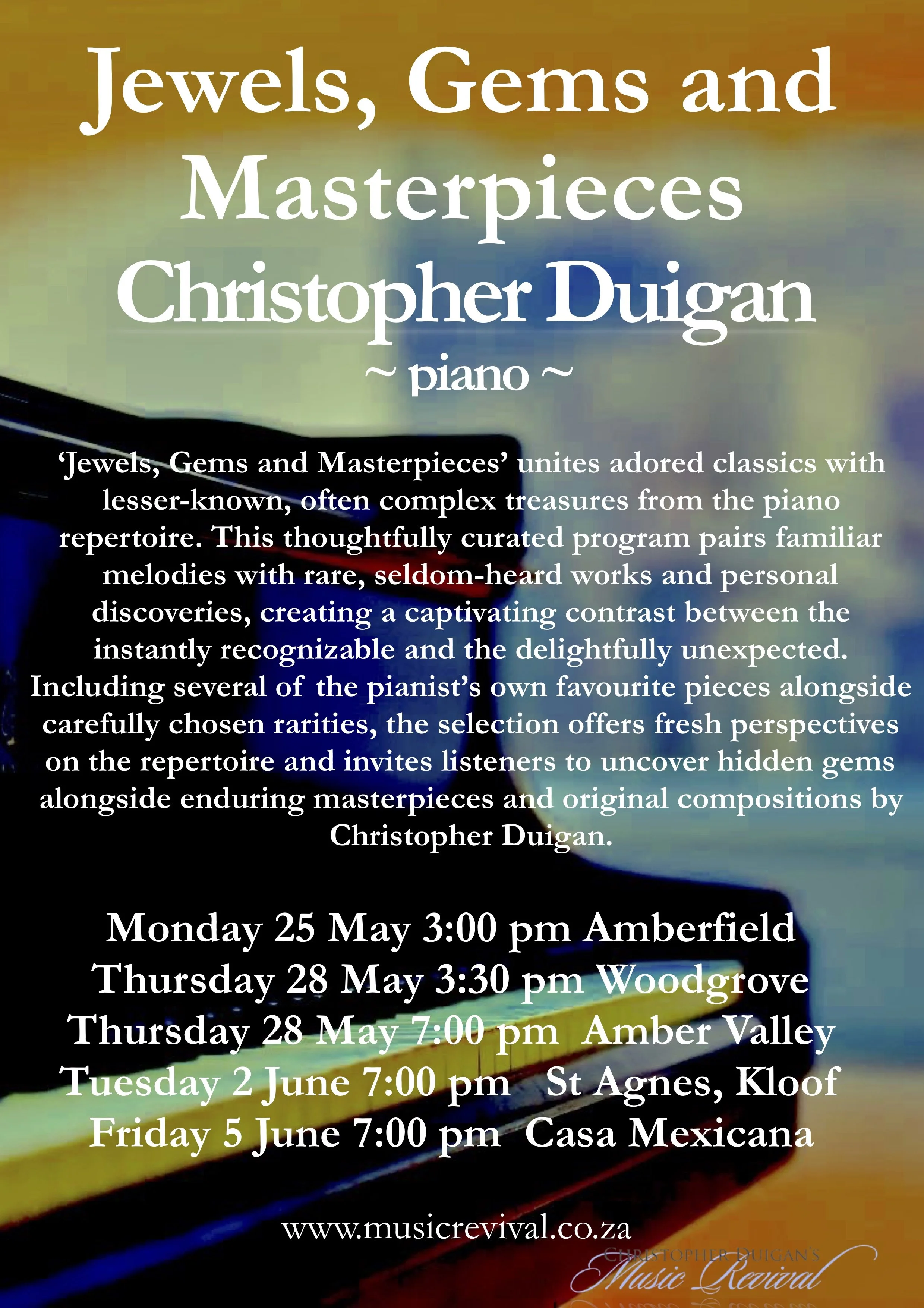
‘Jewels, Gems and Masterpieces’ unites beloved classics with lesser-known, often complex treasures from the piano repertoire. This thoughtfully curated program pairs familiar melodies of upliftment and loss with rare, seldom-heard works and personal discoveries, creating a captivating contrast between the instantly recognizable and the delightfully unexpected. Including several of the pianist’s own favourite pieces alongside carefully chosen rarities, the selection offers fresh perspectives on the repertoire and invites listeners to uncover hidden gems alongside enduring masterpieces.
Monday 25 May 3:00 pm Amberfield
Thursday 28 May 3:30 pm Woodgrove
Thursday 28 May 7:00 pm Amber Valley
Tuesday 2 June 7:00 pm St Agnes, Kloof
Friday 5 June 7:00 pm Casa Mexicana
Around the World in 80 Minutes
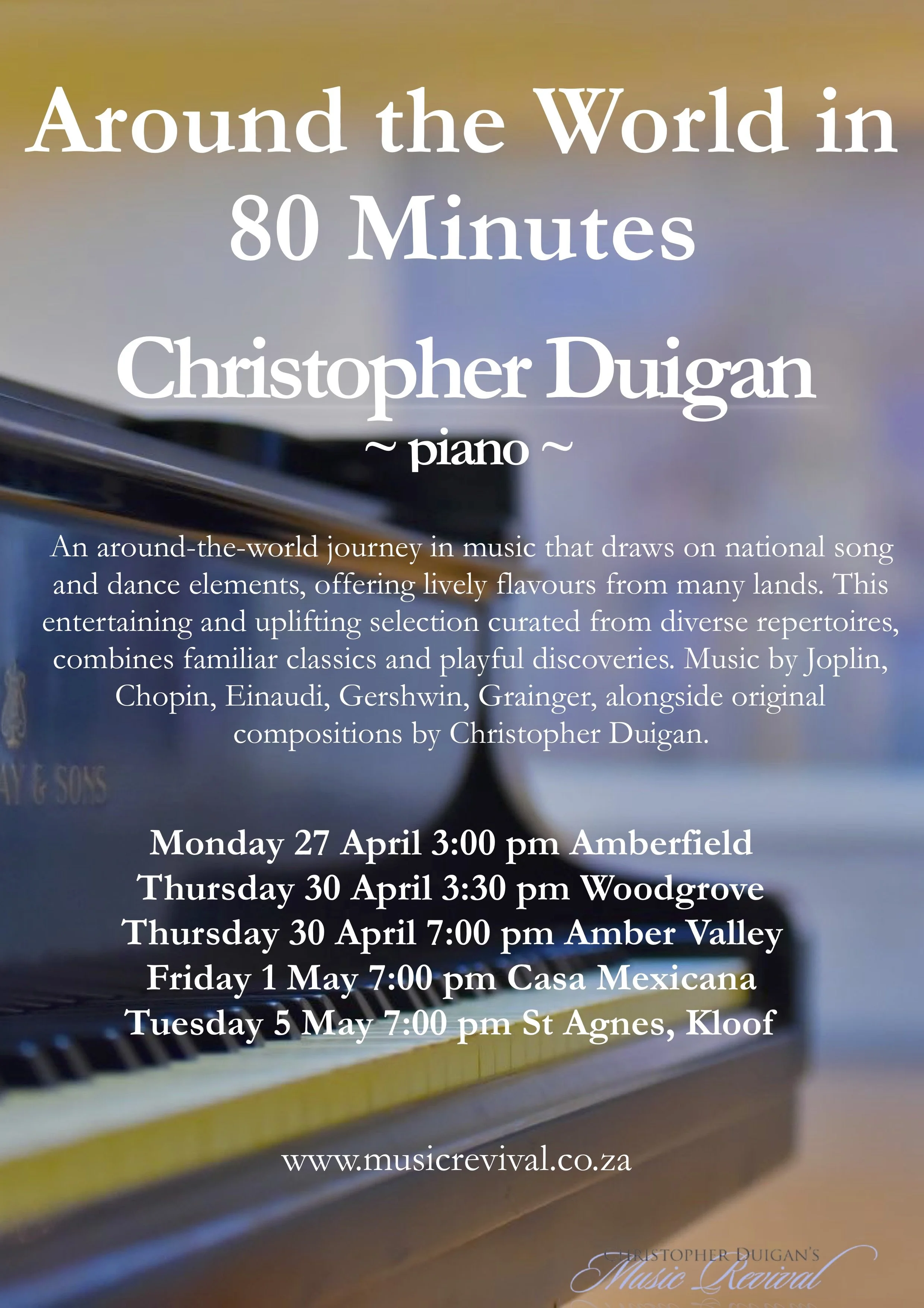
An around-the-world musical journey that draws on national song and dance elements, offering lively, colorful flavors from many lands. An entertaining and joyous program, carefully curated from diverse repertoires and blending familiar classics with playful new discoveries. Selections include music by Joplin, Chopin, Einaudi, Gershwin, Grainger, alongside original compositions and arrangements by Christopher Duigan.
Thursday 30 APRIL 3:30 pm
WOODGROVE - Community Centre, Pietermaritzburg
Tickets : R100 Booking via WhatsApp 083 417 4473 or booking@musicrevival.co.za
This concert is open to all.
Thursday 30 APRIL 7:00 pm
AMBER VALLEY - Amber Auditorium
Tickets: R100 Booking: Amber office.
(Open to Amber Valley residents and their guests).
Friday 1 MAY 7:00 pm
CASA MEXICANA 35 Montgomery Drive, Pietermaritzburg
Tickets: R300 concert and dinner after or R150 concert only.
Venue opens at 6:30 pm. Performance time approx 60 mins at 7:00 pm.
Secure patrolled parking.
BOOKING IS ESSENTIAL : Book via WhatsApp 083 417 4473 or booking@musicrevival.co.za.
Please include your contact numbers in all e-mail bookings.
Tuesday 5 MAY 7:00 pm
ST AGNES CHURCH, Kloof
Tickets: R150 include tea/coffee and other refreshments at interval, inclduing a glass of wine and Wedgewood nougat.
Booking preferred via WhatsApp 083 417 4473 or booking@musicrevival.co.za
Musical Notes and Anecdotes
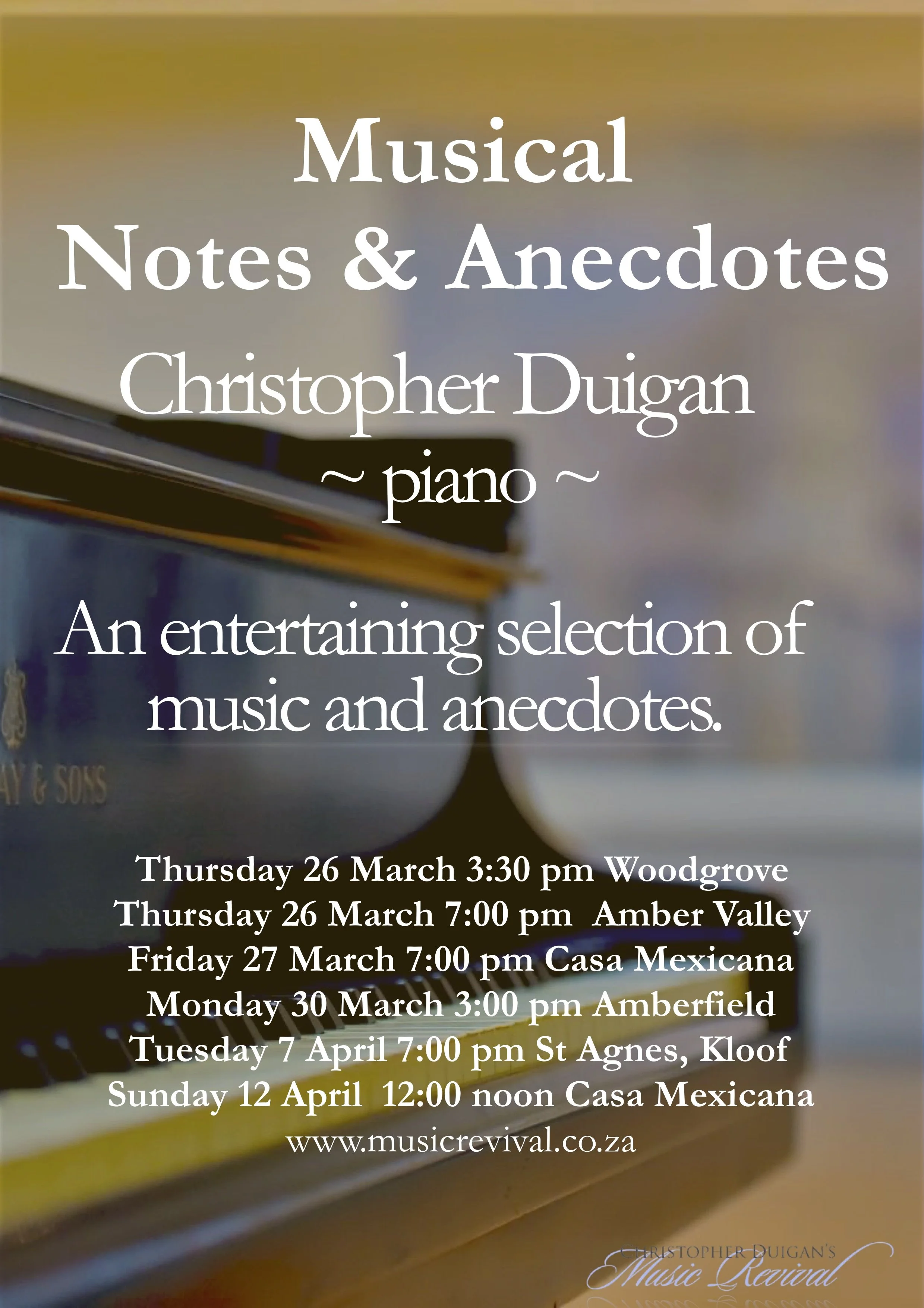
An entertaining selection of music and anecdotes. Christopher Duigan compiles a charming volume of amusing anecdotes and reflections about music, musicians, composers and pianists. What they said, why they said it, and what some wish they hadn’t said!
Thursday 26 MARCH 3:30 pm
WOODGROVE - Community Centre, Pietermaritzburg
Tickets : R100 Booking via WhatsApp 083 417 4473 or booking@musicrevival.co.za
This concert is open to all!
Thursday 26 MARCH 7:00 pm
AMBER VALLEY - Amber Auditorium
Tickets: R100 Booking: Amber office.
(Open to Amber Valley residents and their guests).
Friday 27 MARCH 7:00 pm
CASA MEXICANA 35 Montgomery Drive, Pietermaritzburg
Tickets: R300 concert and dinner after or R150 concert only.
Venue opens at 6:30 pm. Performance time approx 60 mins at 7:00 pm.
Secure patrolled parking.
BOOKING IS ESSENTIAL : Book via WhatsApp 083 417 4473 or booking@musicrevival.co.za.
Please include your contact numbers in all e-mail bookings.
Monday 30 MARCH 3:00 pm
AMBERFIELD, Howick
Tickets: R80
Booking: Amberfield Office. 033 230 2000
This concert is open to all!
Tuesday 7 APRIIL 7:00 pm
ST AGNES CHURCH, Kloof
Tickets: R150 include tea/coffee and other refreshments at interval.
Booking preferred via WhatsApp 083 417 4473 or booking@musicrevival.co.za
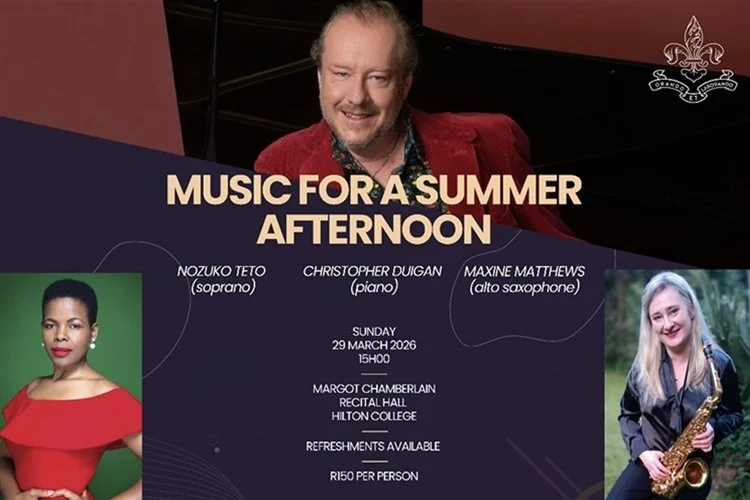
Music for a Summer Afternoon
Sunday 29 March at 3:00 pm.
Margot Chamberlain Recital Room, HILTON COLLEGE
Book here
Soprano, Nozuko Teto, will be joined by Maxine Matthews (saxophone) and international concert pianist, Christopher Duigan in “Music for a summer Afternoon” at Hilton College on Sunday 29 March 2026 at 15h00. This delightful musical treat is an afternoon not to be missed!
Music lovers can look forward to an entertaining performance by star soprano, Nozuko Teto , singing Italian operatic arias from "La bohème", and "La Wally", complemented by classical, traditional songs and sacred music “The Holy City”, “Panis Angelicus”. Nozuko Teto was born in Bizana, Eastern Cape. She obtained her Bachelor of Music from the University of KwaZulu Natal and received her post- graduate diploma in opera from the University of Cape Town as a student of Kamal Khan and Virginia Davids. Thanks to a scholarship from the Nicolai Ghiaurov Foundation she was able to study with the famous soprano Mirella Freni at her CUBEC Academy. During her time in Europe, she has sung in many concerts at the Teatro Comunale Pavarotti in Modena with the Puccini Festival Orchestra, in Amsterdam with the Concertgebouw Orchestra, and with the Rotterdam Symphony.
Maxine Matthews-Meyer presents a selection of Duigan’s own compositions including the popular ‘Bar Stool Tango' and ‘Himeville' from 'Four KZN Landscapes’. Born in Mauritius, Maxine began studies under Werner Dannewitz in Durban before heading to Greece and France to complete a Diplome de Perfectionement with distinction in Besançon, France, under the renowned classical saxophonists Cecile Dubois and Laurent Blanchard. Having been featured in Music Revival concerts 2012-14, including the annual Parklane Superspar Christmas Concert in the City Hall, Matthews-Meyer joined the teaching staff at The Wykeham Collegiate in Pietermaritzburg at the start of this year.
Christopher Duigan, well known to local audiences for his ongoing series of classical performances across KZN, plays selections from recent programmes including music by Chopin and Liszt.
In February we bring you “Music for a Summer Evening (or Afternoon)”.
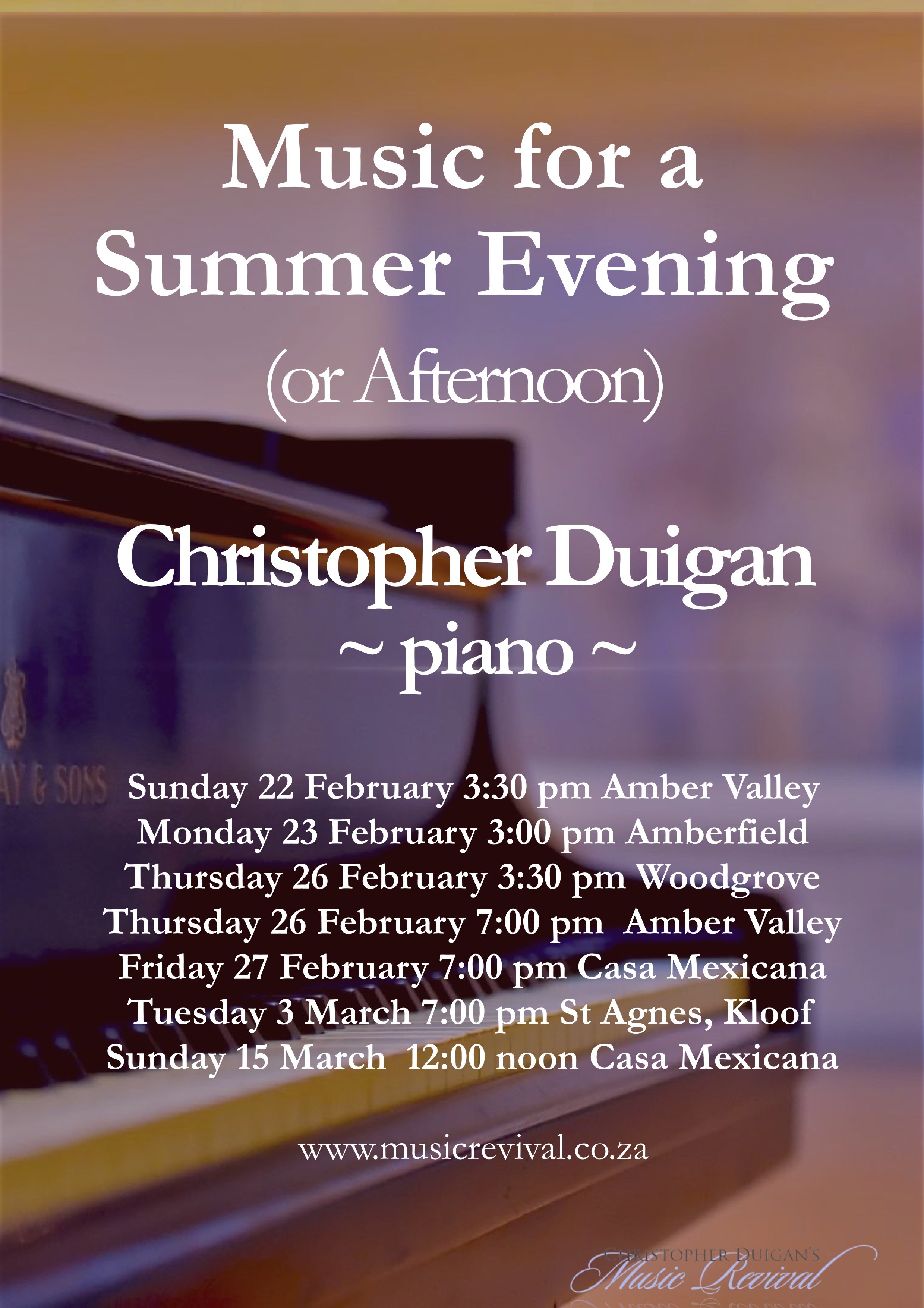
Music for a Summer Evening (or Afternoon).
Christopher Duigan brings to local audiences an evocative programme titled “Music for a Summer Evening (or Afternoon).”
This eclectic repertoire, drawn from many cultures, time periods and genres, offers a breezy, contented sequence of moods inspired by a summer’s evening: balmy atmosphere, the warmth of the day, a cool passing breeze, the occasional storm, and touches of melancholy and bliss woven through the selections. The programme features works by Balakirev, Beethoven, Chopin, Einaudi, Gershwin — and original pieces by Duigan himself. The variety is intentional: familiar favourites sit alongside lesser-known gems, so you may be comforted and surprised in equal measure.
What a splendid way to spend an afternoon or evening in beautiful company.
Sunday 22 FEBRUARY 3:30 pm
AMBER VALLEY - Amber Auditorium
Tickets: R100 Booking: Amber office.
(Open to Amber Valley residents and their guests).
Monday 23 FEBRUARY 3:00 pm
AMBERFIELD, Howick
Tickets: R80
Booking: Amberfield Office. 033 230 2000
This concert is open to all!
Thursday 26 FEBRUARY 3:30 pm
WOODGROVE - Community Centre, Pietermaritzburg
Tickets : R100 Booking via WhatsApp 083 417 4473 or booking@musicrevival.co.za
This concert is open to all!
Thursday 26 FEBRUARY 7:00 pm
AMBER VALLEY - Amber Auditorium
Tickets: R100 Booking: Amber office.
(Open to Amber Valley residents and their guests).
Friday 27 FEBRUARY 7:00 pm
CASA MEXICANA 35 Montgomery Drive, Pietermaritzburg
Tickets: R300 concert and dinner after or R150 concert only.
Venue opens at 6:30 pm. Performance time approx 60 mins at 7:00 pm.
Secure patrolled parking.
BOOKING IS ESSENTIAL : Book via WhatsApp 083 417 4473 or booking@musicrevival.co.za.
Please include your contact numbers in all e-mail bookings
Tuesday 3 MARCH 7:00 pm
ST AGNES CHURCH, Kloof
Tickets: R150 include tea/coffee and other refreshments at interval.
Booking preferred via WhatsApp 083 417 4473 or booking@musicrevival.co.za
Please note the increased ticket price for 2026!
Sunday 15 MARCH 12:00 noon
CASA MEXICANA 35 Montgomery Drive, Pietermaritzburg
Tickets: R300 concert and lunch after or R150 concert only.
Venue opens at 11:30 am. Performance time approx 60 mins at 12:00 noon.
Secure patrolled parking.
BOOKING IS ESSENTIAL : Book via WhatsApp 083 417 4473 or booking@musicrevival.co.za.
Please include your contact numbers in all e-mail bookings.
We’re excited to present a fresh, intimate series that celebrates light, warmth and the timeless pleasure of live music. While the previously advertised concerts in association with Coffeeberry, Hilton will no longer be proceeding due to logistical reasons, we’ve created a welcoming new option that captures the same spirit — with added charm and authenticity.
Introducing a Sunday midday concert + lunch at Casa Mexicana
What: A relaxed, curated piano recital by Christopher Duigan paired with a freshly prepared lunch.
When: A Sunday midday event in March (details and dates above).
Where: Casa Mexicana — an inviting daytime setting with intimate indoor seating and access to the garden.
Why: Enjoy a harmonious music-and-lunch experience, followed by a leisurely stroll through the garden in daylight.
Join us Experience summer music in the bright comfort of a Sunday midday — delicious food, intimate piano, and the restorative calm of the garden. Please contact us to reserve your place or to request specific dates and menu information.
SALT ROCK / UMHLALI CONCERTS
After much consideration, I have decided to end the current monthly concerts at Salt Rock /Umhlali. The performance on Sunday the 8th February was the last in the current series. thank you to everyone who supported..
I will reassess the situation once the N3 construction upgrades are completed and we are able to put better arrangements in place. I am truly sad to make this decision — the audience has been wonderfully supportive — but regular attendance numbers and a number of practical issues have made it unviable at present.
For those in Ballito, Salt Rock and Durban please also note the concerts at Friends of Music in Durban.
OUR JANUARY 2026 CONCERT
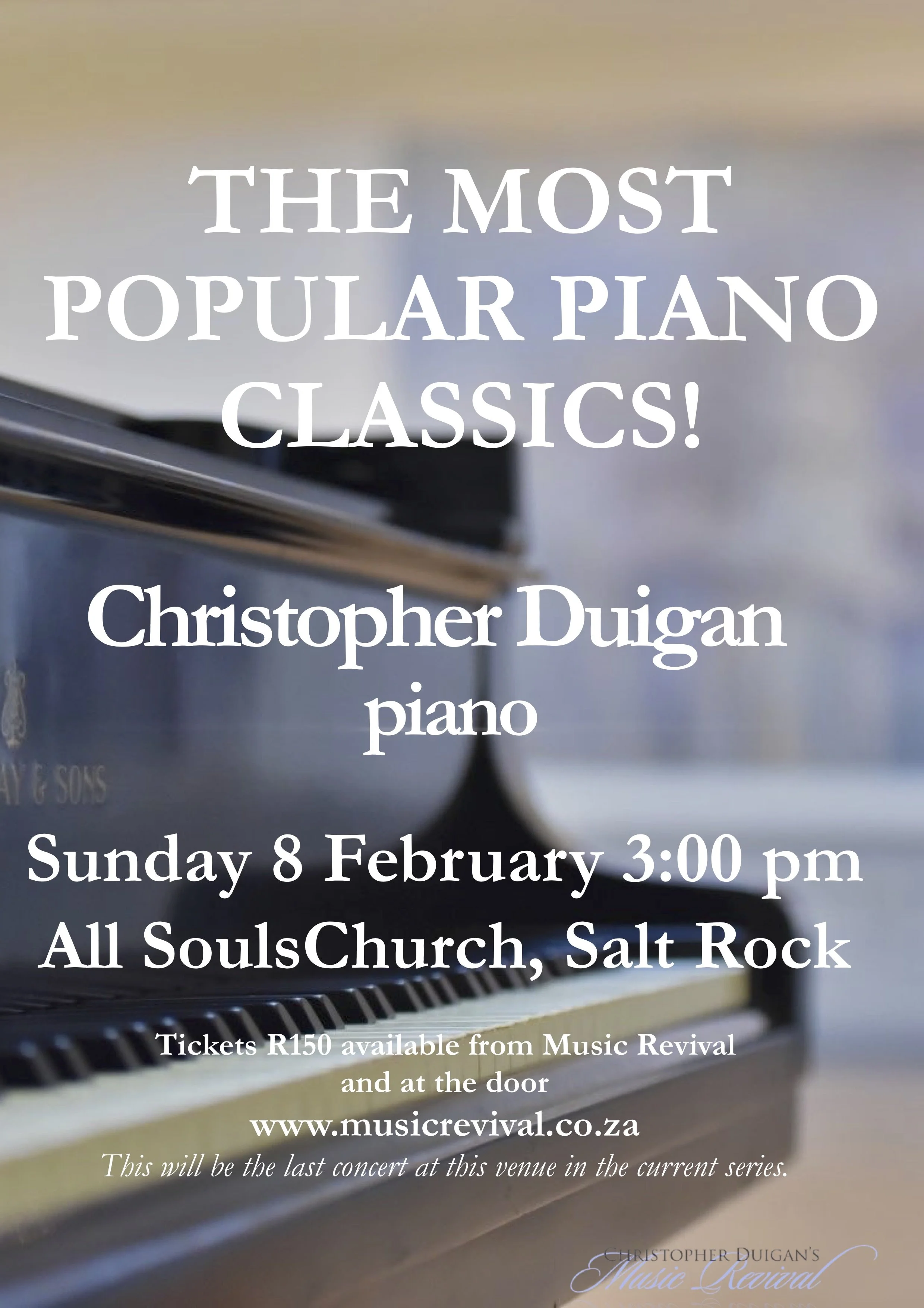
The Most Popular Classics!’
Christopher Duigan begins the year on a particularly high note with a sparkling programme titled ‘The Most Popular Classics!’. Renowned for their brilliance, dramatic energy and unforgettable melodies, these enduring staples or ‘war-horses’ of the concert piano repertoire continue to deliver immense listening pleasure and sustained excitement. And with good reason — their power to move and captivate audiences remains undiminished. What a splendid way to usher in the new year.
For this carefully chosen selection, Christopher presents Beethoven’s ‘Moonlight’ Sonata and ‘Jesu, Joy of Man’s Desiring’, alongside Liszt’s dazzling ‘La campanella’ and the fiery Hungarian Rhapsody No. 2, plus Debussy’s atmospheric ‘Clair de lune’, the charming ‘Rustle of Spring’ and many other beloved favourites.
Please be advised that there will be no concert in Salt Rock in January, as the series currently staged at that venue is under consideration and undergoing re-evaluation. We are also reviewing the Amber Valley performances and planning to try a double outing, including a Sunday afternoon concert, to determine what best suits the Amber Valley community.
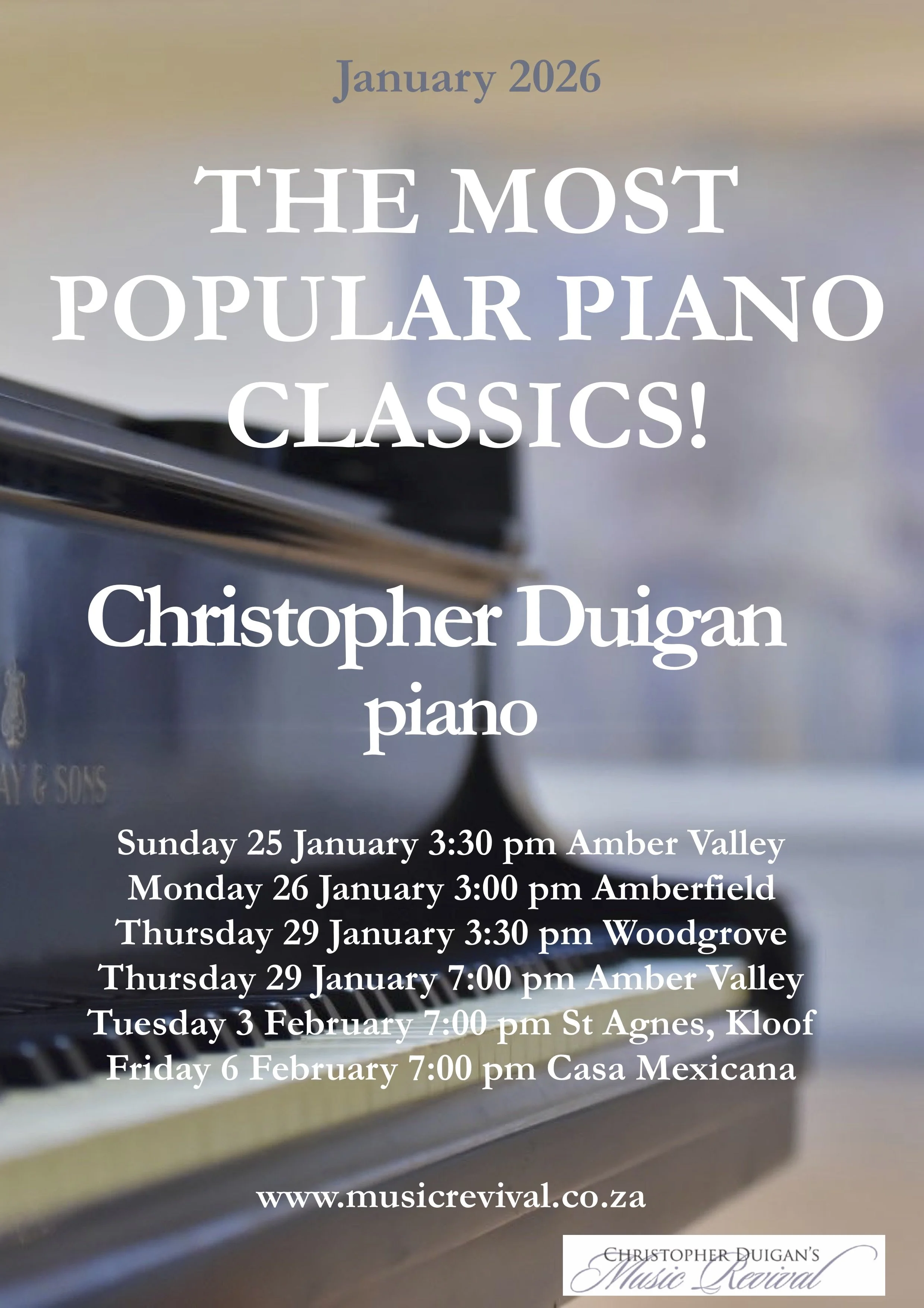
Tuesday 3 FEBRUARY 7:00 pm
ST AGNES CHURCH, Kloof
Tickets: R150 include tea/coffee and other refreshments at interval.
Booking preferred via WhatsApp 083 417 4473 or booking@musicrevival.co.za
Please note the increased ticket price for 2026!
Friday 6 FEBRUARY 7:00 pm
CASA MEXICANA 35 Montgomery Drive, Pietermaritzburg
Tickets: R300 concert and dinner after. R150 concert only.
Venue opens at 6:30 pm. Performance time approx 60 mins.
Secure patrolled parking.
BOOKING IS ESSENTIAL : Book via WhatsApp 083 417 4473 or booking@musicrevival.co.za.
Please include your contact numbers in all e-mail bookings
Sunday 8 FEBRUARY 3:00 pm
ALL SOULS ANGLICAN CHURCH
Sheffield Beach Rd, Umhlali / Salt Rock
Tickets: R150 include tea/coffee and other refreshments at interval.
Booking preferred via WhatsApp 083 417 4473 or booking@musicrevival.co.za
Previously …
Sunday 25 JANUARY 3:30 pm
AMBER VALLEY - Amber Auditorium
Tickets: R100 Booking: Amber office.
(Open to Amber Valley residents and their guests).
Monday 26 JANUARY 3:00 pm
AMBERFIELD, Howick
Tickets: R80
Booking: Amberfield Office. 033 230 2000
This concert is open to all!
Thursday 29 JANUARY 3:30 pm
WOODGROVE - Community Centre, Pietermaritzburg
Tickets : R100 Booking via WhatsApp 083 417 4473 or booking@musicrevival.co.za
This concert is open to all!
Thursday 29 JANUARY 7:00 pm
AMBER VALLEY - Amber Auditorium
Tickets: R100 Booking: Amber office.
(Open to Amber Valley residents and their guests).
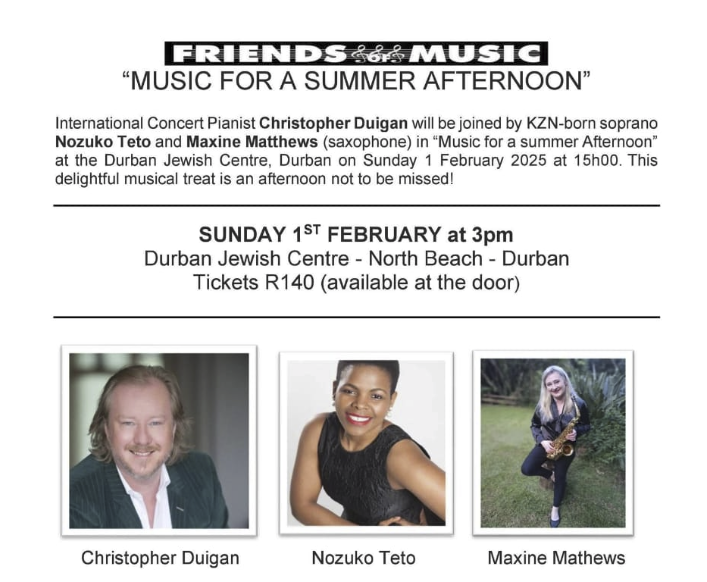
Tickets are R140 each and are available for purchase at the door.
For more information contact friendsofmusic@gmail.co.za or phone Keith on 0715051021.
The Durban Jewish Centre is at 44 K. E. Masinga Road, Durban (Old Fort Road) just past the Onomo Hotel. These is secure parking at the venue.
December 2025
Music Revival Concerts in KZN with Christopher Duigan for the year ending December 2025
December 2025
Music Revival Concerts in KZN with Christopher Duigan for the year ending December 2025
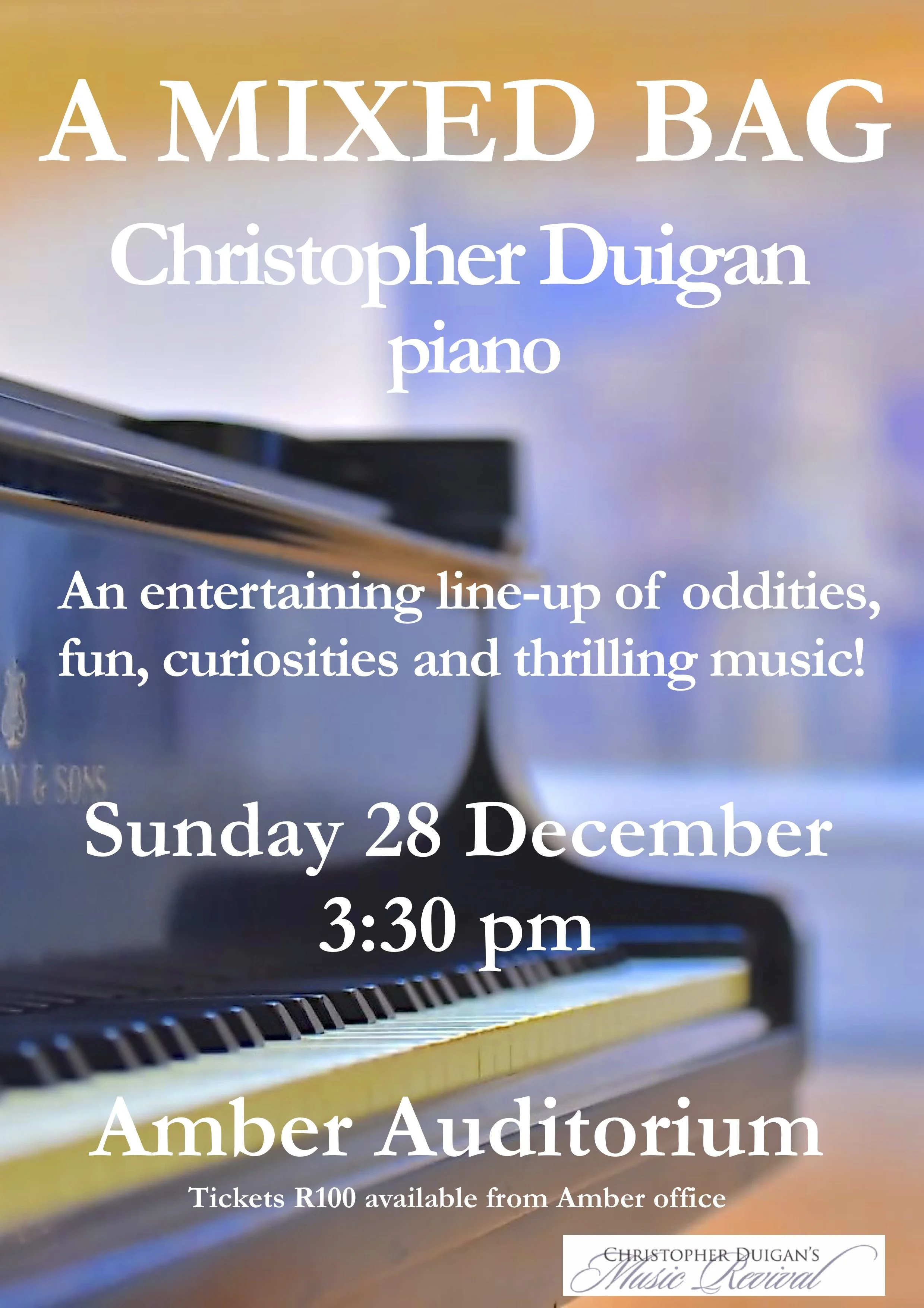
Our DECEMBER CONCERT - A MIXED BAG
While we don’t usually promote a monthly KZN concert at the end of December, due to an overwhelming response and request for year-end events, this year we will. Christopher Duigan ends the year on a light-hearted note! The compilation is of rarities, oddities, popular favourites and highlights from this year’s programmes.
Sunday 28 DECEMBER 3:30 pm
AMBER VALLEY - Amber Auditorium
Tickets: R100 Booking: Amber office.
This concert open to Amber Valley residents and their guests. Please find a Amber Valley friend to invite you to this once-off afternoon concert!
Monday 29 DECEMBER 3:30 pm
WOODGROVE - Community Centre, Pietermaritzburg
Tickets : R100 Booking via WhatsApp 083 417 4473 or booking@musicrevival.co.za
This concert is open to all including the general public! Bring your friends to this special event!
Wednesday 31 DECEMBER 7:00 pm
CASA MEXICANA 35 Montgomery Drive, Pietermaritzburg
Tickets: R150 concert Add R200 (TBC) for dinner after
Venue opens at 6:30 pm. Performance time approx 60 mins.
Secure patrolled parking.
BOOKING IS ESSENTIAL : Book via WhatsApp 083 417 4473 or booking@musicrevival.co.za.
Please include your contact numbers in all e-mail bookings
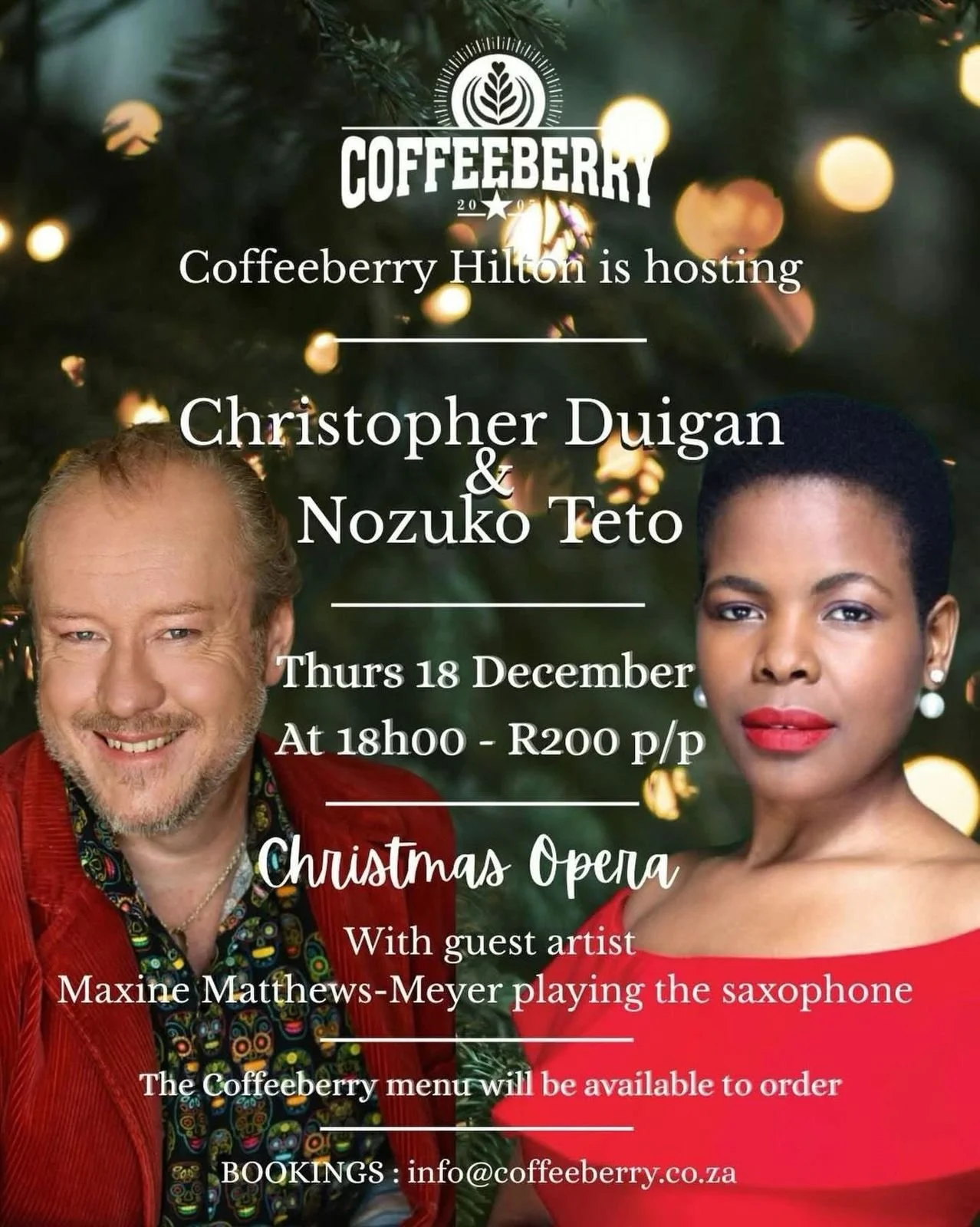
Christmas Opera at the Avenues
KZN-born soprano, Nozuko Teto, will be joined by Maxine Matthews-Meyer (saxophone) and international concert pianist, Christopher Duigan, for “Christmas Opera at the Avenues” at the Coffeeberry Avenues, Hilton on Thursday 18 December 2025 at 18h00. This delightful musical treat, with opportunity to enjoy a delicious dinner, is an evening not to be missed!
Music lovers can look forward to an entertaining performance by star soprano, Nozuko Teto , singing Italian operatic arias from "La bohème", and "La Wally", complemented by classical and traditional songs and seasonal music; “O Holy Night”. “The Holy City”, “Panis Angelicus” “ Silent Night” and other carols.
Christmas Opera at the Avenues
Coffeeberry, Avenues Hilton
Thursday 18 December 2025 at 18h00
Coffeeberry Hilton Avenues, Cnr Hilton College Road &, Elizabeth Dr, Hilton,
Cover for the concert is R200.
Booking is essential as space is limited.
Full menu available from 6:00 pm. Performance starts approx 8: 00 pm
BOOKING : info@coffeeberry.co.za to reserve your table.
Our NOVEMBER CONCERT
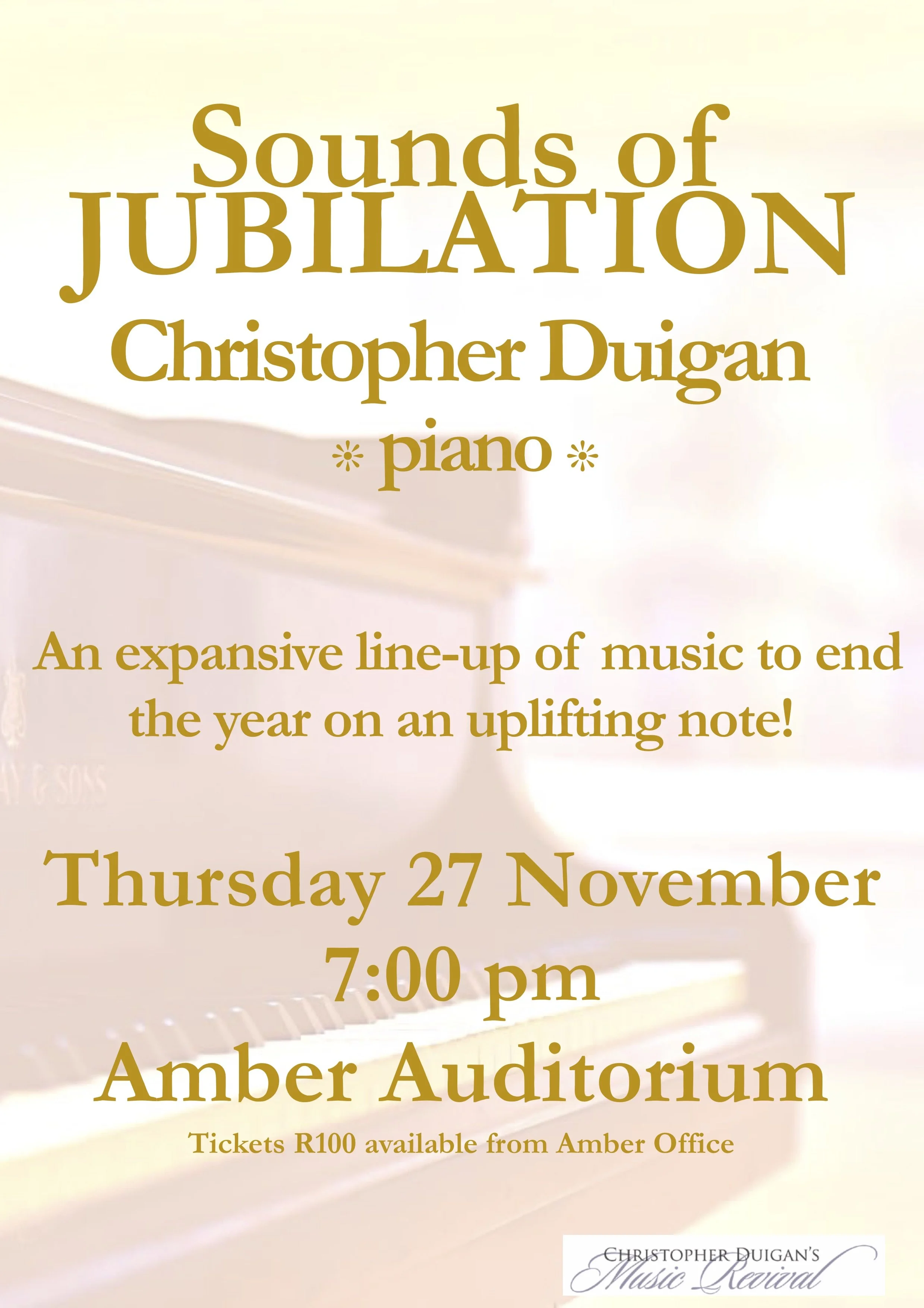
Christopher Duigan ends the year on an celebratory note! In a programme that spans an expansive range of genres, formats and musical styles, the central theme is one of joy and upliftment. Includes Chopin Ballade No 3, Frog Legs Rag, the tango La Nocturna, Gershwin’s Three Preludes, and a seasonal Christmas whisper.
Monday 24 NOVEMBER 3:00 pm
AMBERFIELD, Howick
Tickets: R80
Booking: Amberfield Office. 033 230 2000
This concert is open to all!
Thursday 27 NOVEMBER 3:30 pm
WOODGROVE - Community Centre, Pietermaritzburg
Tickets : R100 Booking via WhatsApp 083 417 4473 or booking@musicrevival.co.za
This concert is open to all!
Thursday 27 NOVEMBER 7:00 pm
AMBER VALLEY - Amber Auditorium
Tickets: R100 Booking: Amber office.
(Open to Amber Valley residents and their guests).
Tuesday 2 DECEMBER 7:00 pm
ST AGNES CHURCH, Kloof
Tickets: R130 include tea/coffee and other refreshments at interval.
Booking preferred via WhatsApp 083 417 4473 or booking@musicrevival.co.za
Please be advised that there is no Salt Rock concert in late November or December due to the church beingbusy with other end of year and fundraising functions.
DATE TBC 7:00 pm
CASA MEXICANA 35 Montgomery Drive, Pietermaritzburg
Tickets: R250 concert and dinner after.
Venue opens at 6:30 pm. Performance time approx 60 mins.
Secure patrolled parking.
BOOKING IS ESSENTIAL : Book via WhatsApp 083 417 4473 or booking@musicrevival.co.za.
Please include your contact numbers in all e-mail bookingsWe have had to postpone this concert due to very low bookings and clash with the rugby! Also the concert we have on Sunday at Hilton is splitting our numbers. We will try again later in December.
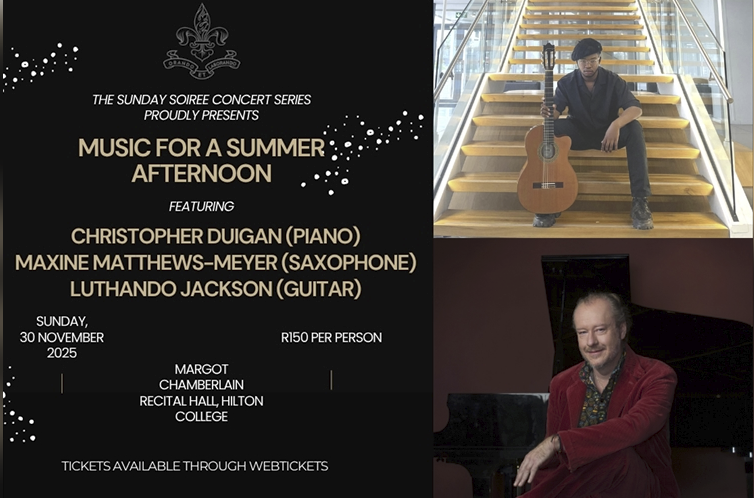
Music for a Summer Afternoon
CHRISTOPHER DUIGAN (PIANO)
MAXINE MATTHEWS-MEYER (SAXOPHONE)
LUTHANDO JACKSON (GUITAR)
Chamberlain Music Centre (Hilton College)
Sunday 30 November 2025
15h00
Tickets: R150, available through Webticket (here) and at the door.
Local music lovers are in for a treat with a triple bill of artists sharing the stage at the Chamberlain Music Centre at Hilton College on Sunday 30 November. The concert, which offers a feast of music, starts at 3:00 pm.
Luthando Jackson, a popular and highly acclaimed young artist, recognised as the 'young maestro of Pietermaritzburg’, will be featured in the special event along with Maxine Matthews-Meyer (saxophone) and Christopher Duigan (piano).
Jackson focusses on the classical guitar repertoire playing a selection of Latin guitar music by Augustine Barrios-Mangore, Roland Dynes, Zequinha De Abreu and Heitor Villa Lobos. A largely self taught guitarist, Jackson was invited to attend the prestigious Menuhin School in Surrey, England in 2018/19 and is currently enrolled in B Mus studies at Nelson Mandela UIniversity in Gqeberha.
Maxine Matthews-Meyer presents a selection of Duigan’s own compositions including the popular ‘Bar Stool Tango' and ‘Himeville' from 'Four KZN Landscapes’. Born in Mauritius, Maxine began studies under Werner Dannewitz in Durban before heading to Greece and France to complete a Diplome de Perfectionement with distinction in Besançon, France, under the renowned classical saxophonists Cecile Dubois and Laurent Blanchard. Having been featured in Music Revival concerts 2012-14, including the annual Parklane Superspar Christmas Concert in the City Hall, Matthews-Meyer joined the teaching staff at The Wykeham Collegiate in Pietermaritzburg at the start of this year.
Christopher Duigan, well known to local audiences for his ongoing series of classical performances across KZN, plays selections from recent programme including music by Chopin and Liszt.
Tickets are available from Quicket
PREVIOUSLY …
The Magic of CHOPIN

The programme for October will feature an all-Chopin recital, which I will be presenting with great enthusiasm and heartfelt dedication. This exciting initiative is inspired by the outstanding and brilliantly talented young pianists who are currently performing in Warsaw at the prestigious International Competition. It truly is a feast of top-quality music combined with excellent production, all generously made available for free on YouTube!
Observing these performances over the past few days has reminded me of the subtlety, balance, and delicate susceptibility inherent in Chopin's music, qualities that add remarkable depth and nuance to moments of improvisation and structural features alike. For this recital, I will be selecting pieces from the competition’s prescribed repertoire I have been following closely, including the Ballade No. 3, the ‘brilliant’ Waltzes in E-flat and A-flat, and the technically demanding etudes from Opus 25.
Previously …
Monday 27 October 3:00 pm
AMBERFIELD, Howick
Tickets: R80
Booking: Amberfield Office. 033 230 2000
This concert is open to all!
Thursday 30 October 3:30 pm
WOODGROVE - Community Centre, Pietermaritzburg
Tickets : R100 Booking via WhatsApp 083 417 4473 or booking@musicrevival.co.za
This concert is open to all!
Thursday 30 October 7:00 pm
AMBER VALLEY - Amber Auditorium
Tickets: R100 Booking: Amber office.
(Open to Amber Valley residents and their guests).
ST AGNES CHURCH, Kloof
Tickets: R130 include tea/coffee and other refreshments at interval.
Booking preferred via WhatsApp 083 417 4473 or booking@musicrevival.co.za
Friday 7 November 7:00 pm
CASA MEXICANA 35 Montgomery Drive, Pietermaritzburg
Tickets: R250 concert and dinner after.
Venue opens at 6:30 pm. Performance time approx 60 mins.
Secure patrolled parking.
BOOKING IS ESSENTIAL : Book via WhatsApp 083 417 4473 or booking@musicrevival.co.za.
Please include your contact numbers in all e-mail bookings
Sunday 9 November 3:00 pm
ALL SOULS ANGLICAN CHURCH
Sheffield Beach Rd, Umhlali / Salt Rock
Tickets: R150 include tea/coffee and other refreshments at interval.
Booking preferred via WhatsApp 083 417 4473 or booking@musicrevival.co.za
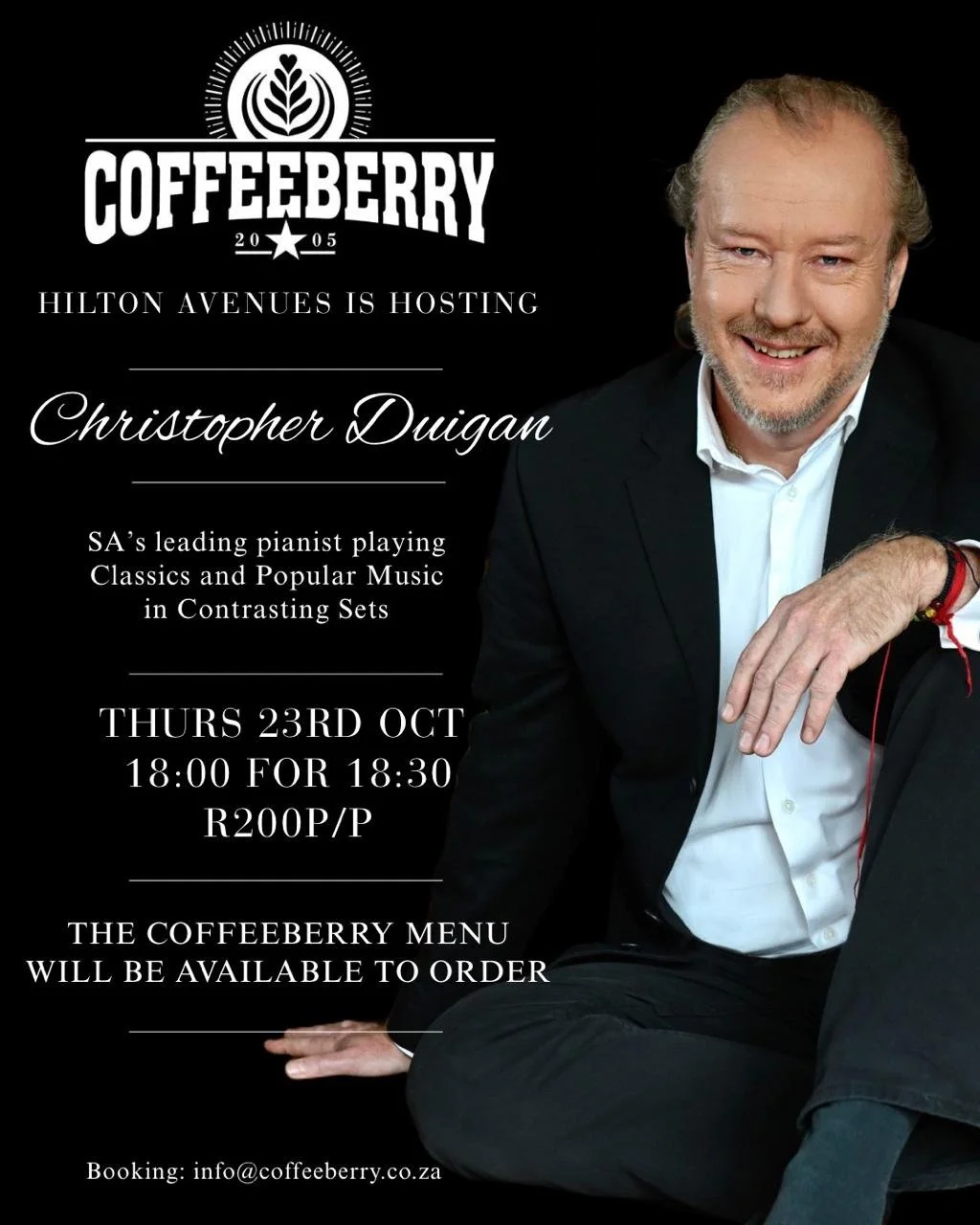
Tuesday 4 November 7:00 pm
Join us for an exciting evening at Coffeeberry-Avenues in Hilton!
I will be travelling with my concert grand piano, and there will be a raised stage with a camera view of the keyboard on big screens.
Programme features highlights from my recent selection ‘Tales from My Piano’!
The acoustics are impressive, creating an immersive concert experience! The full Coffeeberry menu is available for dinner.
All bookings email info@coffeeberry.co.za only!
-
The Annual Dean’s Concert returns with all the glamour and musical excellence that make it one of the University of Johannesburg’s most anticipated events. Presented by (UJ) Arts & Culture, a division of the Faculty of Art, Design and Architecture (FADA), and led by Professor Federico Freschi, Executive Dean of FADA, this year’s Dean’s Concert takes on special meaning in celebrating the University of Johannesburg’s 20th anniversary. Mark your calendars for 1 November.
Since 2016, the annual Dean’s Concert has united celebrated musicians with emerging talent in support of a bursary fund, established by Professor Freschi, that aids academically deserving students with limited financial resources.
Professor Freschi, affectionally known as the “Singing Dean” and acclaimed pianist and composer Christopher Duigan once again join forces in the musical direction of the concert which features some new voices, and much-loved favourites.
Cape Town-born soprano Yolisa Ngwexana brings international sparkle to the Dean’s Concert, joining Professor Freschi in a selection of arias and duets from Verdi’s La Traviata. These masterpieces, celebrated for their lyrical beauty and emotional intensity, showcase the dramatic power that has made Ngwexana a rising star in opera houses across three continents.
Currently covering the role of Clorinda in Rossini’s La Cenerentola with London’s English National Opera, Ngwexana’s journey reflects remarkable artistic transformation. After earning her biotechnology diploma from Cape Peninsula University of Technology in 2018, she pivoted to music, graduating with distinction from North West University in 2022. Since then, Ngwexana has taken her opera career to new heights, performing in various roles both in South Africa and abroad.
No Dean’s Concert would be complete without the award-winning UJ Choir. A cornerstone of UJ Arts & Culture, the choir’s remarkable vocal range and versatile voices have become synonymous with musical excellence at the university. Once again, they bring to stage their signature repertoire that moves seamlessly from African to Western choral music.
“What makes this annual concert truly special is how it embodies our belief in FADA and UJ that great art and great purpose are inseparable. As we celebrate the University of Johannesburg’s 20th anniversary, this concert reminds us how far we’ve come in nurturing artistic talent. We are a community that ensures that artistic and academic potential can flourish regardless of economic circumstance,” states Professor Freschi.
“When audiences experience the soaring melodies of Verdi alongside our talented students and distinguished guests, they become part of something larger,” he notes.
“I am delighted to return as musical director for this year’s annual Dean’s Concert at UJ,” says Christopher Duigan, who is considered one of South Africa’s leading concert pianists and has performed extensively with all major South African orchestras and across national and international festivals in a repertoire of more than 25 works for piano and orchestra in over 100 performances since his professional debut in 1991.
“It is always an evening of music that uplifts, inspires and moves and I am looking forward to collaborating with Yolisa and Prof Freschi in the Verdi arias and duets. Beyond the performance, this really is an evening that honours Prof Freschi’s commitment to supporting students,” he continues.
Over and above the concert there will an auction of art from both well-known and emerging artists that will go further to support the fund.
Tickets for the Dean’s Concert are R250pp, and bookings are essential.
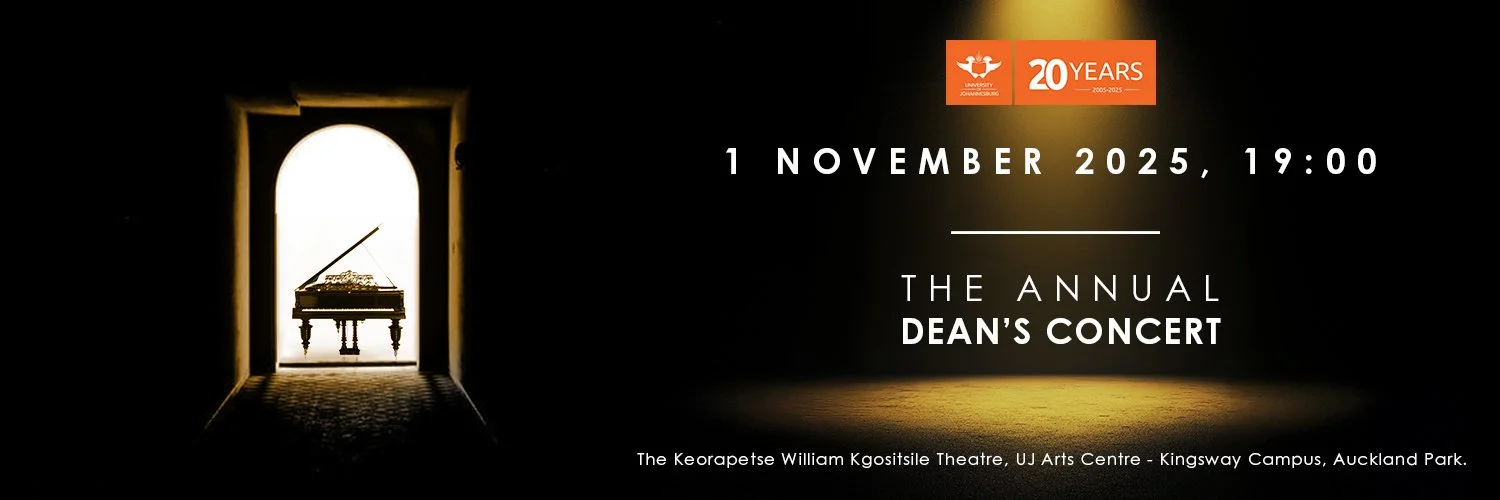
The Annual Dean's Concert returns with all the glamour and musical excellence that make it one of the University of Johannesburg’s most anticipated cultural events. Presented by UJ Arts & Culture, a division of the Faculty of Art, Design and Architecture (FADA), and led by Professor Federico Freschi, Executive Dean of FADA, this year’s concert holds special significance as it celebrates the University of Johannesburg’s 20th anniversary.
Affectionately known as the “Singing Dean”, Professor Freschi once again joins forces with acclaimed pianist and composer Christopher Duigan to direct an unforgettable evening of music. The programme introduces fresh new voices alongside much-loved favourites, offering audiences a rich and diverse musical experience.
Adding international sparkle, Cape Town-born soprano Yolisa Ngwexana takes to the stage, while the award-winning UJ Choir, a cornerstone of UJ Arts & Culture, delivers its signature blend of versatility and vocal excellence.Book here
IN OCTOBER …
The Magic of CHOPIN
The programme for October will feature an all-Chopin recital, which I will be presenting with great enthusiasm and heartfelt dedication. This exciting initiative is inspired by the outstanding and brilliantly talented young pianists who are currently performing in Warsaw at the prestigious International Competition. You can watch their extraordinary performances daily until October 23.
It truly is a feast of top-quality music combined with excellent production, all generously made available for free on YouTube!
Observing these performances over the past few days has reminded me of the subtlety, balance, and delicate susceptibility inherent in Chopin's music, qualities that add remarkable depth and nuance to moments of improvisation and structural features alike. For this recital, I will be selecting pieces from the competition’s prescribed repertoire I have been following closely, including the Ballade No. 3, the ‘brilliant’ Waltzes in E-flat and A-flat, and the technically demanding etudes from Opus 25.
Monday 27 October 3:00 pm
AMBERFIELD, Howick
Tickets: R80
Booking: Amberfield Office. 033 230 2000
This concert is open to all!
Thursday 30 October 3:30 pm
WOODGROVE - Community Centre, Pietermaritzburg
Tickets : R100 Booking via WhatsApp 083 417 4473 or booking@musicrevival.co.za
This concert is open to all!
Thursday 30 October 7:00 pm
AMBER VALLEY - Amber Auditorium
Tickets: R100 Booking: Amber office.
(Open to Amber Valley residents and their guests).
Tuesday 4 November 7:00 pm
ST AGNES CHURCH, Kloof
Tickets: R130 include tea/coffee and other refreshments at interval.
Booking preferred via WhatsApp 083 417 4473 or booking@musicrevival.co.za
Friday 7 November 7:00 pm
CASA MEXICANA 35 Montgomery Drive, Pietermaritzburg
Tickets: R250 concert and dinner after.
Venue opens at 6:30 pm. Performance time approx 60 mins.
Secure patrolled parking.
BOOKING IS ESSENTIAL : Book via WhatsApp 083 417 4473 or booking@musicrevival.co.za.
Please include your contact numbers in all e-mail bookings
Sunday 9 November 3:00 pm
ALL SOULS ANGLICAN CHURCH
Sheffield Beach Rd, Umhlali / Salt Rock
Tickets: R150 include tea/coffee and other refreshments at interval.
Booking preferred via WhatsApp 083 417 4473 or booking@musicrevival.co.za
In September …
‘Tales from My Piano’ is another fascinating and varied programme from the ongoing monthly concerts presented across KZN by pianist Christopher Duigan. This captivating series continues to showcase his exceptional talent and deep musical expression, offering audiences a rich and engaging experience each month.
In September Music Revival Concerts proudly presents Christopher Duigan in an easy-going and enjoyable programme that beautifully blends classical and popular music, enriched with intriguing anecdotes and personal stories shared by the artist. The carefully curated programme is arranged in pairs of contrasting pieces, each pair exploring different musical moods and textures—from heavy to light, sleepy to anxious, celestial to earthy, and much more. This delightful selection features works by Debussy, Liszt, and Prokofiev, including enchanting excerpts from ‘Romeo and Juliet’. Audiences will also enjoy Scott Joplin’s vibrant ‘Elite Syncopations’, Chopin’s elegant ‘Minute’ Waltz, the iconic and playful Kitten on the Keys by Zez Confrey, alongside special compositions by Ruth Hall, a remarkable 108-year-old resident of Howick.

COLD AS SNOW Claude Debussy - Des pas sur la neige (from
WARM AS THE NIGHT Ludovico Einaudi - Due Tramonti
DIAPHANOUS Franz Liszt - Waldesrauchen
MASSIVE Sergei Prokofiev - Montagues and Capulets
GRIEF Yann Tiersen - Sur le fil piano
DELIGHT Scott Joplin - Elite Syncopations
RESTFUL JS Bach - Aria from Goldberg Variations
ANXIOUS Aleksander Scriabin - Etude, Op. 42 No. 5
CELESTIAL Arvo Pärt: Variationen zur Gesundung von Arinuschka
BITTERSWEET Percy Grainger - Bridal Lullaby
ABSTRACT Christopher Duigan - Days of Solitude: Day 17
LOCAL Ruth Hall - By Cooling Streams, Tango, Veld Fires
UNIVERSAL Fredric Chopin - Scherzo No 2
CATS ... Zez Confrey - Kitten on the Keys
& DOGS Frederic Chopin - Valse Op 64 No. 1 "Minute Waltz”
ECONOMY Luis Milan - Pavan Nos. 1 & 5
BUSINESS CLASS Franz Liszt - Réminiscences de Lucia di Lammermoor
This concert …
Thursday 25 September 3:30 pm WOODGROVE
Thursday 25 September 7:00 pm AMBER VALLEY
Friday 26 September 7:00 pm CASA MEXICANA
Monday 29 September 3:00 pm AMBERFIELD
Sunday 5 October 3:00 pm ALL SOULS, Salt Rock
Tuesday 7 October 7:00 pm ST AGNES CHURCH, Kloof
Thursday 25 September 3:30 pm
WOODGROVE - Community Centre, Pietermaritzburg
Tickets : R100 Booking via WhatsApp 083 417 4473 or booking@musicrevival.co.za
This concert is open to all!
Thursday 25 September 7:00 pm
AMBER VALLEY - Amber Auditorium
Tickets: R100 Booking: Amber office.
(Open to Amber Valley residents and their guests).
Friday 26 September 7:00 pm
CASA MEXICANA 35 Montgomery Drive, Pietermaritzburg
Tickets: R250 concert and dinner after.
Venue opens at 6:30 pm. Performance time approx 60 mins.
Secure patrolled parking.
BOOKING IS ESSENTIAL : Book via WhatsApp 083 417 4473 or booking@musicrevival.co.za.
Please include your contact numbers in all e-mail bookings
Monday 29 September 3:00 pm
AMBERFIELD, Howick
Tickets: R80
Booking: Amberfield Office. 033 230 2000
This concert is open to all!
Sunday 5 October 3:00 pm
ALL SOULS ANGLICAN CHURCH
Sheffield Beach Rd, Umhlali / Salt Rock
Tickets: R150 include tea/coffee and other refreshments at interval.
Booking preferred via WhatsApp 083 417 4473 or booking@musicrevival.co.za
Tuesday 7 October7:00 pm
ST AGNES CHURCH, Kloof
Tickets: R130 include tea/coffee and other refreshments at interval.
Booking preferred via WhatsApp 083 417 4473 or booking@musicrevival.co.za
In August …
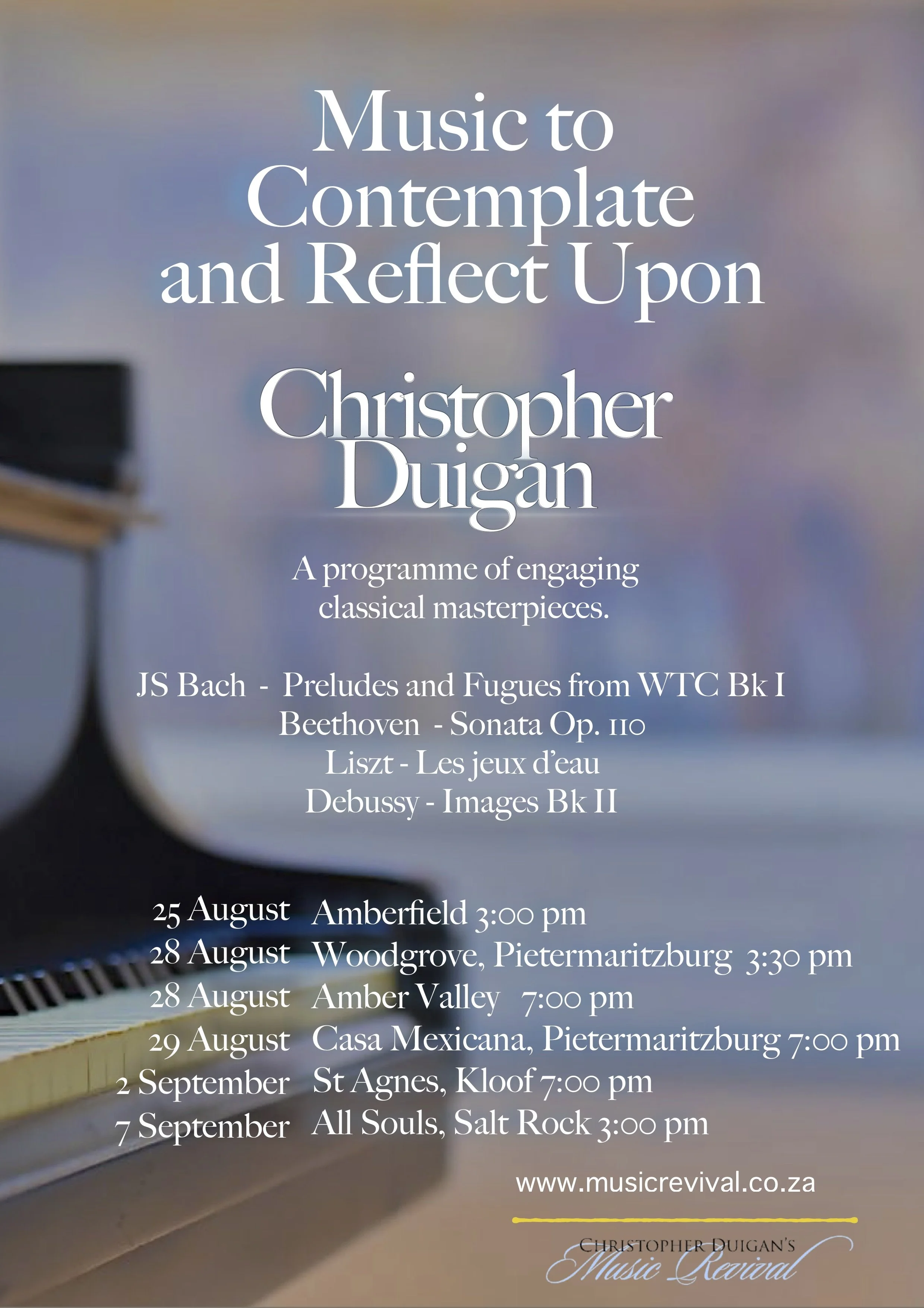
This August, Music Revival Concerts proudly presents Christopher Duigan in an exceptional programme of classical masterpieces that engage, stimulate, and invite deep contemplation. The concert features Beethoven’s profound Sonata Op. 110, one of his enigmatic late sonatas composed in the final years of his life. Complementing this is Liszt’s shimmering and evocative ‘Les jeux d’eaux à la villa d’Este,’ a dazzling piece that captures the essence of water in motion. Debussy’s exquisite Second Book of ‘Images,’ including the luminous ‘Poisson d’or,’ adds a quixotic impressionistic touch to the evening. The programme opens with a distilled selection of Preludes and Fugues from Bach’s monumental Well-Tempered Clavier, setting an inspiring and thoughtful stage for this unforgettable musical journey. Join us to experience these timeless works brought to life with artistry and eloquence.
Monday 25 August 3:00 pm
AMBERFIELD, Howick
Tickets: R80
Booking: Amberfield Office. 033 230 2000
This concert is open to all!
Thursday 28 August 3:30 pm
WOODGROVE - Community Centre, Pietermaritzburg
Tickets : R100 Booking via WhatsApp 083 417 4473 or booking@musicrevival.co.za
This concert is open to all!
Thursday 28 August 7:00 pm
AMBER VALLEY - Amber Auditorium
Tickets: R100 Booking: Amber office.
(Open to Amber Valley residents and their guests).
Friday 29 August 7:00 pm
CASA MEXICANA 35 Montgomery Drive, Pietermaritzburg
Tickets: R150 concert only.
Venue opens at 6:30 pm. Performance time approx 60 mins.
Secure patrolled parking.
BOOKING IS ESSENTIAL : Book via WhatsApp 083 417 4473 or booking@musicrevival.co.za.
Please include your contact numbers in all e-mail bookings
Tuesday 2 September 7:00 pm
ST AGNES CHURCH, Kloof
Tickets: R130 include tea/coffee and other refreshments at interval.
Booking preferred via WhatsApp 083 417 4473 or booking@musicrevival.co.za
Sunday 7 September 3:00 pm
ALL SOULS ANGLICAN CHURCH
Sheffield Beach Rd, Umhlali / Salt Rock
Tickets: R150 include tea/coffee and other refreshments at interval.
Booking preferred via WhatsApp 083 417 4473 or booking@musicrevival.co.za

After the recent Open Gardens Weekends, we’re delighted to invite you to an Open House Sunday lunch, offering a wonderful opportunity to explore the entire house and garden at a leisurely pace. To enhance the experience, I will be performing short music sessions in the studio, on the veranda, and out in the garden between 12:30 and 3:00 pm. Guests are welcome to enjoy a relaxed lunch, comfortably seated in the studio, on the sunny veranda, nestled on a sofa, or out on the terraces surrounded by nature. Convenient and secure parking is also available for all attendees.
Sunday 24 August
Casa Mexicana - 35 Montgomery Drive, Athlone
Open 12:00 noon to 3:00 pm
Entry : R350
Read here the amazing story of Wedgewood Nougat and Christopher’s beginnings as Music Revival - click here
I receive so many requests for the details of these two pieces whenever I play them. Here are my recordings of these on YouTube!
In JuLY …
MUSIC IN THE GARDENS
GREAT CLASSICAL MELODIES with Christopher DUGAN (piano)

In July we present an outstanding collection of beautiful classical melodies. We all like a great tune, and especially one we know! This programme brings together a number of these winning pieces including Bach ‘Jesu Joy’, Mozart ‘Rondo all turca’, Liszt ‘Hungarian Rhapsody No 2 and Chopin ‘Military’ Polonaise.
Monday 28 July 3:00 pm
AMBERFIELD, Howick This concert is open to all!
Tickets: R80
Booking: Amberfield Office. 033 230 2000
Thursday 31 July 3:30 pm
WOODGROVE - Community Centre, Pietermaritzburg
Tickets : R100 Booking via WhatsApp 083 417 4473 or booking@musicrevival.co.za
This concert is open to all!
Thursday 31 July 7:00 pm
AMBER VALLEY - Amber Auditorium
Tickets: R100 Booking: Amber office. (Open to Amber Valley residents and their guests).
Friday 1 August 7:00 pm
CASA MEXICANA 35 Montgomery Drive, Pietermaritzburg
Tickets: R100 concert. Add-on meal soup and dessert after - R150.
Venue opens at 6:30 pm. Performance time - 60 mins.
Secure patrolled parking.
BOOKING IS ESSENTIAL : Book via WhatsApp 083 417 4473 or booking@musicrevival.co.za.
Please include your contact numbers in all e-mail bookings.
Sunday 3 August 3:00 pm
ALL SOULS ANGLICAN CHURCH
Sheffield Beach Rd, Umhlali / Salt Rock
Tickets: R150 include tea/coffee and other refreshments at interval.
Booking preferred via WhatsApp 083 417 4473 or booking@musicrevival.co.za
Tuesday 5 August 7:00 pm
ST AGNES CHURCH, Kloof
Tickets: R130 include tea/coffee and other refreshments at interval.
Booking preferred via WhatsApp 083 417 4473 or booking@musicrevival.co.za
Visit the Casa Mexicana page for pics of the garden and its development.

If you have not experienced ‘Music in the Garden’ don’t miss the last session of this autumn and winter season.
Saturday 26 and Sunday 27 July
Casa Mexicana - 35 Montgomery Drive, Athlone
Open 10:00 am to 3:00 pm
Entry : R50
In June …
TOGETHER AGAIN
JAMES GRACE (guitar) and Christopher DUGAN (piano)
Please note Coffeeberry concerts at both Avenues and Cascades have been cancelled due to unforeseen circumstances. Apologies for the disappointment.
Local audiences should not miss an opportunity to enjoy a beautiful concert of music featuring world-class soloists, pianist Christopher Duigan and guitarist James Grace, across KZN!
Duigan, one of South Africa’s leading concert pianists, can be heard in piano solos from his recent programmes of music by Chopin and Liszt. Together with guitarist James Grace, the Duigan & Grace Duo, an usual combination of piano and guitar, has won a popular following at major festivals and on stages across South Africa. Cape Town-based James Grace is a SAMA nominated artist with a string of successful recordings under his belt. Their programme together includes many of their own duo arrangements and improvisations on classic melodies, jazz standards, Latin milongas and Spanish classics. Their session will include ‘Fields of Gold’, ‘Tico Tico’ and favourite Spanish guitar solos. Duigan’s own composition ‘Indigo’ a favourite at any Duigan and Grace concert, will complete the programme.
-
Thursday 26 June 3:30 pm
WOODGROVE - Community Centre
Tickets : R100 Booking via WhatsApp 083 417 4473 or booking@musicrevival.co.za
This concert is open to all! -
Thursday 26 June 7:00 pm
AMBER VALLEY - Amber Auditorium
Tickets: R100 Booking: Amber office. (Open to Amber Valley residents and their guests). -
Sunday 29 June Salt Rock 3:00 pm
ALL SOULS ANGLICAN CHURCH
Sheffield Beach Rd, Umhlali / Salt Rock
Tickets: R150 include tea/coffee and other refreshments at interval.
Booking preferred via WhatsApp 083 417 4473 or booking@musicrevival.co.za -
Monday 30 June 3:00 pm
Amberfield
Tickets: R80
Booking: Amberfield Office.
Open to all! -
Tuesday 1 July 7:00 pm
ST AGNES CHURCH, Kloof
Tickets: R130 include tea/coffee and other refreshments at interval.
Booking preferred via WhatsApp 083 417 4473 or booking@musicrevival.co.za -
R220 pp
6:00 for 6:30 pm
A concert grand piano, and there will be a raised stage with a camera view of the keyboard and guitar on big screens. The acoustics are impressive, creating an immersive concert experience!
A full menu is available.
Booking essentail email info@coffeeberry.co.za.
-
R220 pp
6:00 for 6:30 pm
A concert grand piano, and there will be a raised stage with a camera view of the keyboard and guitar on big screens. The acoustics are impressive, creating an immersive concert experience!
A full menu is available.
Booking essentail email info@coffeeberry.co.za.
-
Tere are two shows to chose from. 15:30 or 18:00. Tickets are R100 per person. Buy your drink from the bar and enjoy this lovely show in the conference room. Bookings Le Domaine Ext 8000
Open to residents and their guests only.
-
FRIENDS OF MUSIC, Durban Jewish Centre - Durban
Sunday 6 July 14h30
Tickets: R140 at the door.
Booking: millark.millar@gmail.com or 0715051021

IN HILTON
The recent concert at Coffeeberry, Avenues in Hilton confirmed once again what a fantastic venue and experience this is! I hope to be featuring guest artist James Grace (guitar) in my next outing there in the first week of July. Once again I move my concert grand piano, there will be a raised stage, plus a camera view of the keyboard and artists on big screens. The acoustics are impressive, creating an immersive and memorable concert experience! A full menu is available for those who wish to enjoy a delicious meal. Details to be announced shortly.
JUNE EDITION! Open Gardens
Saturday 21 & Sunday 22 June
Casa Mexicana - 35 Montgomery Drive, Athlone PIETERMARITZBURG
Open 9:00 am to 5:00 pm
Visit the new web page for before pics of the garden and its development.
Casa Mexicana - 35 Montgomery Drive, Athlone PIETERMARITZBURG
Open 9 am to 5 pm
Secure Parking
Tea/Coffee and other refreshments
Art exhibition by established artists
Music in the Garden with Christopher Duigan (piano) at 10 am, 12 noon, 2 pm and 4 pm (15 mins)
Talk: The Story of Casa Mexicana ~ House and Garden 12:15 pm (15 mins)
Lunch - light lunch of soup will be available. Booking for lunch is preferred as places are limited. Email chris@musicrevival.co.za or WhatsApp message 083 417 4473 in advance
Entrance : R50
Following the resounding success of the first of Blackwood's Midlands Open Gardens of 2025, and by popular request, we open the garden, and home, at Casa Mexicana once again in June and July (Saturday 26 and Sunday 27 July).
Entrance fee is R50, which includes patrolled street parking for your convenience, as well as tea, superb coffee, and a variety of other refreshments including Wedgwood Angel biscuits. There will be an engaging art exhibition to view with work from local artists in the studio, as well as various artworks to purchase. Throughout the day, there will be delightful music in the garden performed by Christopher Duigan at the piano, with sessions scheduled at 10:00 am,12 noon, 2:00 pm, and 4:00 pm, each lasting approximately 15 minutes.
Additionally there will be a short presentation from Christopher detailing the story of the creation of the Casa Mexicana garden and its development over 30 years.
Adding to the experience guests can now also enjoy a light lunch of soup and dessert available from 12h30. Booking for lunch is preferred as places and facilities are limited. Email chris@musicrevival.co.za or WhatsApp message 0834177473 in advance to reserve a place.
Expect seasonal changes as the plectranthus and other shrubs finish flowering, aloes take on full bloom, and autumn hues turn to winter in this magnificent indigenous garden. There will be more flowering orchids too.
Join us at Casa Mexicana on Sat 21 & Sun 22 June for a unique garden experience. Explore the stunning indigenous garden designed by Barry Lovegrove, featuring terraced slopes, bold architecture, and beautifully layered garden rooms. Enjoy live piano performances by Christopher Duigan, an art exhibition, and delicious treats included with your R50 entrance fee.
Don't miss this perfect blend of nature, art, and music!
In Johannesburg
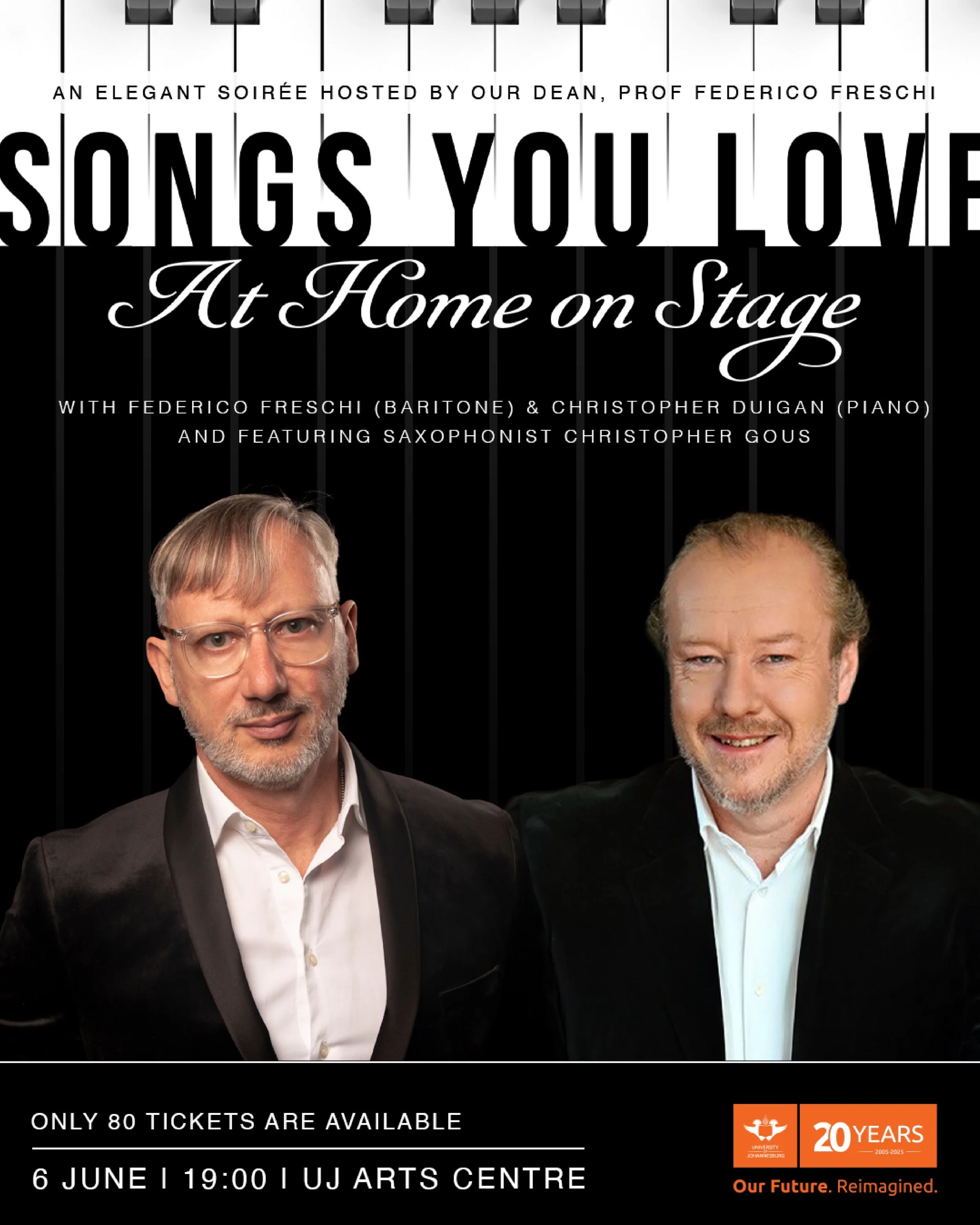
Songs You Love: At Home on Stage invites a small audience to join Executive Dean of the Faculty of Art, Design & Architecture and celebrated baritone Prof Federico Freschi, acclaimed pianist Christopher Duigan, as well as promising young saxophonist Christopher Gous—making a guest appearance—on stage for an intimate and relaxed classical recital.
As a precursor to the popular annual Dean’s Concert fundraiser taking place in November, this special performance presents a selection of popular melodies and piano solos from the world stages of opera, classical repertoire, and musical theatre.
“As we celebrate twenty years of the University of Johannesburg's journey, I'm struck by how deeply the institution has woven itself into the cultural fabric of our city and nation. What began as an ambitious vision has grown into a vibrant hub where creativity and academic excellence intersect in remarkable ways. Songs You Love: At Home on Stage embodies this spirit, creating an intimate space for connection through music that transcends boundaries,” says Professor Federico Freschi.
Audiences can expect well-loved favourites, sung by the Dean himself, from Carmen, The Marriage of Figaro, and My Fair Lady, alongside Neapolitan gems like ’O Sole Mio, and celebrated hits from Cole Porter, Josh Groban, and more. This is an uplifting and engaging programme designed to leave your heart humming and your spirits high.
The recital transforms the performance space into a lounge-style setting with only 80 tickets available. Audience members will be ushered through the stage door and welcomed backstage to enjoy homemade soup and a glass of port before being seated for the performance, in the presence of the majestic UJ Steinway grand piano.
In the same spirit as the annual Dean’s Concert, Songs You Love: At Home on Stage reflects the University of Johannesburg’s and the Dean’s enduring commitment to maintaining the highest standards of quality and expression, giving voice to countless artists and creating unforgettable moments of shared humanity.
Friday 6 June
19:00 – 20:00
Backstage on the Keorapetse William Kgositsile Theatre, UJ Arts Centre, Auckland Park
Limited tickets available — only 80 seats!
Click here to purchase your tickets- > https://tinyurl.com/SongsYouLoveUJ
IN MAY …
LIVES OF THE PIANO!

A thrilling and diverse selection of mostly classical piano music is performed by Christopher Duigan. The engaging and thoughtfully curated program highlights the remarkable and versatile possibilities of the piano, showcasing everything from light and delicate melodies to deep and passionate expressions. It features iconic pieces, such as Mendelssohn’s “Rondo cappricioso'“ and Liszt's "Un Sospiro," as well as Chopin's Scherzo No. 2, intertwined with sections of contemporary meditation and evocative film music. This combination offers a rich and varied listening experience that is sure to captivate and resonate with everyone in attendance.Don't miss this concert!
Monday 26 May 3;00 pm AMBERFIELD
Thursday 29 May 3:30 pm WOODGROVE
Thursday 29 May at 7:00 pm AMBER VALLEY
Tuesday 3 June 7:00 pm ST AGNES CHURCH, Kloof
Sunday 1 June 3:00 pm ALL SOULS, Salt Rock
Thursday 26 May 3:30 pm
WOODGROVE - Community Centre
Tickets : R100 Booking via WhatsApp 083 417 4473 or booking@musicrevival.co.za
This concert is open to all!
Thursday 26 May 7:00 pm
AMBER VALLEY - Amber Auditorium
Tickets: R100 Booking: Amber office. (Open to Amber Valley residents and their guests).
Sunday 1 June Salt Rock 3:00 pm
ALL SOULS ANGLICAN CHURCH
Sheffield Beach Rd, Umhlali / Salt Rock
Tickets: R150 include tea/coffee and other refreshments at interval.
Booking preferred via WhatsApp 083 417 4473 or booking@musicrevival.co.za
Tuesday 3 June 7:00 pm
ST AGNES CHURCH, Kloof
Tickets: R130 include tea/coffee and other refreshments at interval.
Booking preferred via WhatsApp 083 417 4473 or booking@musicrevival.co.za
IN JOHANNESBURG!
Songs You Love: At Home on Stage
with Federico Freschi (baritone) and Christopher Duigan (piano)
The University of Johannesburg’s Faculty of Art, Design & Architecture (FADA) and UJ Arts & Culture will present a unique musical experience on 6 June. The concert offers audiences a rare opportunity to experience two master performers in a setting as warm and personal as the songs themselves.
CONCERTS AT AMBERFIELD IN HOWICK _ OPEN TO ALL
After the recent success of the first concert this week at Amberfield, a second delightful one-hour long afternoon concert is scheduled to take place next month! Many community members have expressed interest in attending additional concerts in the wider Ambers area, in Howick and the KZN Midlands. In response to this demand, and requests for daytime concerts, I am excited to be trialing a monthly concert series at Amberfield, which will be open to everyone, regardless of their residency, for the next three months. The next outing on Monday, 30 June.
PREVIOUSLY ——

I will be performing for the Mzansi Chamber Music Collective in the East Rand this Sunday 4 May. This will be my very first concert outside of KwaZulu-Natal in several years, and I am eagerly looking forward to this exciting opportunity. It promises to be a memorable performance for both myself and the audience. Be sure to click here to book your tickets and join me for this special event.
Join us for an exciting evening at Coffeeberry, Avenues in Hilton. I'll be travelling with my concert grand piano, and there will be a raised stage with a camera view of the keyboard on big screens. The acoustics are impressive, creating an immersive concert experience! A full menu is available. For bookings, email info@coffeeberry.co.za.

The first Blackwood's Midlands Open Garden of the 2025 season is just weeks away!

Casa Mexicana - 35 Montgomery Drive, PIETERMARITZBURG
Open 9:00 am to 5:00 pm
Saturday & Sunday 17 & 18 May
Entrance fee is R50, which includes access to patrolled street parking for your convenience, as well as complimentary tea, coffee, and a variety of other refreshments. Additionally, you can enjoy an engaging art exhibition during your visit. Throughout the day, there will be delightful music in the garden performed by Christopher Duigan on piano, with sessions scheduled at 10:00 am, 12 noon, 2:00 pm, and 4:00 pm, each lasting approximately 15 minutes
Save the dates for a truly immersive garden experience that awaits at Casa Mexicana on Sat 17 & Sun 18 May. This remarkable home of well-known pianist, Christopher Duigan spans nearly three decades of design and devotion. The indigenous garden is a celebrated regional landmark—and for good reason. Crafted by the late Barry Lovegrove, the garden transforms a steep slope into a terraced masterpiece, where indigenous planting and bold architectural features complement each other at every turn.
Thoughtfully layered "garden rooms" and quiet seating areas invite visitors to slow down and soak up the rich details—from intricate stone paving and hand-painted tiles, to a gurgling water feature and a secret forest walk. The indigenous plant palette includes aloes, plectranthus, mature trees and an exquisite collection of potted succulents, offering colour, texture and a strong sense of place. It's a garden that stirs the senses and uplifts the spirit.
The R50 entrance fee includes tea, coffee and delicious treats including Wedgewood Nougat and Angel biscuits - as well as patrolled street parking. An exhibition of museum-quality art by local artists (with works available for purchase) adds a creative touch, and every two hours (10am, 12pm, 2pm, and 4pm), guests will be treated to 15-minute live piano performances in the garden by Christopher Duigan himself.
Don’t miss this harmonious blend of nature, art and music—a garden experience like no other.
Dates: Saturday 17 & Sunday 18 May
Times: 9am - 5pm
Entrance Fee: R50p/p
Address: Casa Mexicana, 35 Montgomery Drive, Athlone, Pietermaritzburg, 3201
Directions: From N3 S - take Peter Brown Dr, turn right at the stop sign. At the circle turn left into Montgomery Drive. From N3 N - take Artmitage Rd/ Sanctuary Rd exit. Keep left on Armitage Rd. At the next circle turn right into Town Bush Rd and left at the next intersection after Greys Hospital (on your left) into Montgomery Dr.
#OpenGarden #BlackwoodsOpenMidlandsGardens #MusicInTheGarden
Christopher Duigan -pianist @opengardensza Open Gardens and Events of South Africa

NEW! CONCERTS at AMBERFIELD
A delightful one-hour long afternoon concert is scheduled to take place at Amberfield! Given that the Amber Valley concerts are exclusively open to Amber Valley residents, many community members have expressed interest in attending additional concerts in the wider Ambers area. In response to this demand, I am excited to announce that I will be trialing a new monthly concert series at Amberfield, which will be open to everyone, regardless of their residency, for the next three months, beginning on Monday, May 26

PREVIOUSLY …
April 2025 The Intimate Art
'The Intimate Art' is the captivating title of a classical piano recital that showcases a beautiful selection of timeless masterpieces skillfully performed by Christopher Duigan (piano). This performance is part of his ongoing monthly outings to various venues throughout the KZN region. The thoughtfully curated programme, focusing on poetic and intimate expression, includes notable works such as Schubert's exquisite selection from Impromptus Op. 142, Liszt's evocative Sonetto 47 del Petrarca, and Chopin's lush Barcarolle Op. 60. Additionally, the recital features the rarely performed delights of Mozart's Rondo K. 511 and Scriabin's poignant Nocturne for Left-hand Op. 9, creating a rich and varied listening experience for all attendees.
Thursday 24 April 3:30 pm
WOODGROVE - Community Centre
Tickets : R100 Booking via WhatsApp 083 417 4473 or booking@musicrevival.co.za
This concert is open to all!
Thursday 24 April at 7:00 pm
AMBER VALLEY - Amber Auditorium
Tickets: R100 Booking: Amber office. (Open to Amber Valley residents and their guests).
Sunday 27 April Salt Rock 3:00 pm
ALL SOULS ANGLICAN CHURCH
Sheffield Beach Rd, Umhlali / Salt Rock
Tickets: R150 include tea/coffee and other refreshments at interval.
Booking preferred via WhatsApp 083 417 4473 or booking@musicrevival.co.za
Tuesday 6 May 7:00 pm
ST AGNES CHURCH, Kloof
Tickets: R130 include tea/coffee and other refreshments at interval.
Booking preferred via WhatsApp 083 417 4473 or booking@musicrevival.co.za
In March…
With a Song and a Prayer

An uplifting and comforting selection of popular classical melodies, and lesser-known gems, collated with unique links and juxtapositions. Follow the programme here
Thursday 27 March 3:30 pm
WOODGROVE - Community Centre
Tickets : R100 Booking via WhatsApp 083 417 4473 or booking@musicrevival.co.za
This concert is open to all!
Thursday 27 March at 7:00 pm
AMBER VALLEY - Amber Auditorium
Tickets: R100 Booking - Amber office open to Amber Valley.
Please note the new ticket price.
This concert with on-screen projection of the hands and keyboard.
Friday 28 March 7:00 pm
CASA MEXICANA 35 Montgomery Drive, Pietermaritzburg
Tickets: R150 concert only. Wine available by donation - R20 per glass or bring your own.
Venue opens at 6:30 pm. Performance time approx 70- mins. Secure patrolled parking.
BOOKING IS ESSENTIAL : Book via WhatsApp 083 417 4473 or booking@musicrevival.co.za. Please include your contact numbers in all email bookings.
Re-imagining our recital format, we return to an immersive experience for evening concerts, without any additional meal options. Guests will be seated in a informal arrangement of sofas and comfortable chairs in the sumptuously appointed studio. The room is generously adorned with magnificent artworks from local artists. The garden is lit at night and is open for your enjoyment - weather permitting.
Tuesday 1 April 7:00 pm
ST AGNES CHURCH, Kloof
Tickets: R130 include tea/coffee and other refreshments at interval.
Booking preferred via WhatsApp 083 417 4473 or booking@musicrevival.co.za
Sunday 6 April Salt Rock 3:00 pm
ALL SOULS ANGLICAN CHURCH
Sheffield Beach Rd, Umhlali / Salt Rock
Tickets: R150 include tea/coffee and other refreshments at interval.
Booking preferred via WhatsApp 083 417 4473 or booking@musicrevival.co.za
February / MARCH - Magnificent Classics

The ‘Magnificent Classics’ programme, a selection of favourires from Duigan’s repertoire, includes George Frederic Handel’s Chaconne in G HWV 435 and Ludwig van Beethoven’s exhilarating ‘Waldstein’ Sonata op 53 – one of his most iconic and revered compositions. Duigan will also play Claude Debussy’s Reflets dans l’eau (Reflections in the water) and Liszt’s Harmonies du soir from his Transcendental Etudes, a powerful and emotionally resplendent composition. The programme ends with the ‘Heroic’ Polonaise in A-flat Op 53 by Frederic Chopin; one of the composer’s boldest compositions and one which gives voice to a nation’s cry for freedom following the Russian invasion of Poland of 1831.
Previously …
This concert is open to all!
Thursday 27 February 3:30 pm
WOODGROVE - Community Centre
Tickets : R100
Booking via WhatsApp 083 417 4473 or booking@musicrevival.co.za
Thursday 27 February at 7:00 pm
AMBER VALLEY - Amber Auditorium
Tickets: R100 Booking - Amber office open to Amber Valley.
Please note new ticket price.
Tuesday 4 March 7:00 pm
ST AGNES CHURCH, Kloof
Tickets: R130 include tea/coffee and other refreshments at interval.
Booking preferred via WhatsApp 083 417 4473 or booking@musicrevival.co.za
Sunday 16 March Salt Rock 3:00 pm
ALL SOULS ANGLICAN CHURCH
Sheffield Beach Rd, Umhlali / Salt Rock
Tickets: R150 include tea/coffee and other refreshments at interval.
Booking preferred via WhatsApp 083 417 4473 or booking@musicrevival.co.za

POPULAR CLASSICS LIGHT - Christopher Duigan (piano) A NEW FORMAT!
EXTRA PERFORMANCE! of this enthusiastically-received programme.
Friday 7 March 7:00 pm
CASA MEXICANA 35 Montgomery Drive, Pietermaritzburg
Tickets: R150 concert only. Wine available by donation - R20 per glass or bring your own.
Venue opens at 6:30 pm. Performance time approx 70- mins. Secure patrolled parking.
BOOKING IS ESSENTIAL : Book via WhatsApp 083 417 4473 or booking@musicrevival.co.za. Please include your contact numbers in all email bookings.
Re-imagining our recital format, we return to an immersive experience for evening concerts, without any additional meal options. Guests will be seated in a informal arrangement of sofas and comfortable chairs in the sumptuously appointed studio, or sometiems known as the salon. The room is generously adorned with magnificent artworks from local artists. Others rooms of the house are also open to view with artworks (some available for purchase) and opportunity enjoy a chat in a cosy corner. The garden is lit at night and is open for your enjoyment - weather permitting.
POPULAR CLASSICS LIGHT
Start the new year with Christopher Duigan at the piano in a popular selection of light piano classics. This calming and charming selection includes Mozart’s Sonata ‘facile’ K. 545, Dvorak’s Humoresque, Rubenstein ‘Melody in F’, ‘The Maiden’s Prayer’, ‘Parade of the Tin Soldiers’ and many more popular classical melodies!
This concert is open to all!
Thursday 30 JANUARY 3:30 pm
WOODGROVE - Community Centre
Tickets : R100
Booking via WhatsApp 083 417 4473 or booking@musicrevival.co.za
Thursday 30 JANUARY at 7:00 pm
AMBER VALLEY - Amber Auditorium
Tickets: R80 Booking - Amber office open to Amber Valley.
We have a new piano!
Tuesday 4 FEBRUARY 7:00 pm
ST AGNES CHURCH, Kloof
Tickets: R130 include tea/coffee and other refreshments at interval.
Booking preferred via WhatsApp 083 417 4473 or booking@musicrevival.co.za
Sunday 9 FEBRUARY Salt Rock 3:00 pm
ALL SOULS ANGLICAN CHURCH
Sheffield Beach Rd, Umhlali / Salt Rock
Tickets: R150 include tea/coffee and other refreshments at interval.
Booking preferred via WhatsApp 083 417 4473 or booking@musicrevival.co.za
December 2024
December 2024
PLAY PIANO PLAY ! An exciting programme for a New Year’s Eve early evening concert at Casa Mexicana.
NEW YEARS’ EVE CONCERT - PLAY PIANO PLAY
Tuesday 31 DECEMBER 7:00 pm
CASA MEXICANA
35 Montgomery Drive, Pietermaritzburg
For the annual new Year’s Eve concert I revive my ‘Play Piano Play!’ programme from earlier in the year. An exciting and highly entertaining performance selection including ragtime, tango, jazz, popular music, and film music along with contemporary meditations along a Neo-Classical line! Includes tango by Plaza and Piazzolla, Gershwin’s ‘Someone to Watch Over me’, ‘Take Five’. the South African anthem ‘Manenberg’, ‘Dizzy Fingers’, my own compositions and music by Einaudi
Tickets: R150 concert only. Bring your own drinks - glasses provided.
Venue opens at 6:30 pm Secure parking.
BOOKING IS ESSENTIAL : Book via WhatsApp 083 417 4473 or booking@musicrevival.co.za. Please include your contact numbers in all email bookings.

Christmas Opera at the Avenues
Pietermaritzburg-born soprano, Bongiwe Madlala, will be joined by her husband Papiki Musa (tenor) and international concert pianist, Christopher Duigan, for “Christmas Opera at the Avenues” at the Coffeeberry Avenues, Hilton on Thursday 19 December 2024 at 18h00. This delightful musical treat, with opportunity to enjoy a delicious dinner, is an evening not to be missed!
Music lovers can look forward to an entertaining performance by star soprano, Bongiwe Madlala, singing Italian operatic arias from "La bohème", "La Traviata" and "La Wally", complemented by classical and traditional songs and seasonal music; “O Holy Night”. “The Holy City”, “Panis Angelicus” “ Silent Night” and other carols.
Christmas Opera at the Avenues
Coffeeberry, Avenues Hilton
Thursday 19 December 2024 at 18h00
Coffeeberry Hilton Avenues, Cnr Hilton College Road &, Elizabeth Dr, Hilton,
Cover for the concert is R195.
Booking is essential as space is limited.
Full/ limited lmenu available from 6:00 pm. Performance start 8: 00 pm
BOOKING : info@coffeeberry.co.za to reserve your table.
Sunday 15 DECEMBER All Souls Church - Salt Rock
DECEMBER 2024
THE BEST OF CHOPIN
A classical programme, a magnificent selection of music from the ‘poet of the piano’ the FrancoPolish composer Frédéric François Chopin. This will include a focus on the elegant, charming, and melodic music from his early years.
Regards,
Christopher Duigan
The Best of CHOPIN
Sunday 15 DECEMBER All Souls, Salt Rock
ALL SOULS ANGLICAN CHURCH
Sheffield Beach Rd, Umhlali / Salt Rock
Tickets: R150 include tea/coffee and other refreshments at interval.
Booking preferred via WhatsApp 083 417 4473 or booking@musicrevival.co.za
Previously …
This concert is open to all!
Thursday 28 NOVEMBER 3:30 pm
WOODGROVE - Community Centre
Tickets : R100
Booking via WhatsApp 083 417 4473 or booking@musicrevival.co.za
We have a new piano!
Tuesday 3 DECEMBER 7:00 pm
ST AGNES CHURCH, Kloof
Tickets: R130 include tea/coffee and other refreshments at interval.
Booking preferred via WhatsApp 083 417 4473 or booking@musicrevival.co.za
Wed 4 at 3:00 pm & Thur 5 DECEMBER at 7:00 pm
AMBER VALLEY - Amber Auditorium
Tickets: R80 Booking - Amber office open to Amber Valley.
Wednesday (only) includes live keyboard camera projection on screen.
Saturday 14 DECEMBER 7:00 pm
CASA MEXICANA
35 Montgomery Drive, Pietermaritzburg
Tickets: R300 includes dinner or R150 concert only.
Venue opens 30 mins before. Secure parking.
BOOKING IS ESSENTIAL : Book via WhatsApp 083 417 4473 or booking@musicrevival.co.za. Please include your contact numbers in all email bookings.
This month …
Don’t miss this months exciting programme ‘Play, Piano Play’!
Includes Liszt -Hungarian Rhapsody No 2, tango by Piazzolla, Gershwin’s ‘Someone to Watch Over me’, ‘Take Five, the South African anthem ‘Mannenberg’, ‘Dizzy Fingers’, my own compositions and music by Einaudi.
We are acquiring a new piano, thanks to a very generous donor, for our Kloof venue at St Agnes! This heralds a new focus for our concerts there.
Also, we are trying an additional day time slot, following several requests, for Amber Valley. This is open to Amber Valley residents and their guests.
The Woodgrove concert on a Thursday afternoon is open to all in Pietermaritzburg!
And please join us for a fantastic ‘Year End Event’ Hilton College!
Plus look out for info on a Johannesburg Concert I am involved in - A Grand Night for Singing, Friday 2 November at University of Johannesburg.
LIVESTREAM SERIES
Last week Wednesday 16 October 2024 I did the final of my at home Livestream Series - No. 289. The attempt to find a small paying audience for these productions has not had suitable response. I have accepted the outcome and ended the project.
Thank you to all who have supported, commented, donated funds for the studio setup, advised technically, and managed the controls since March 2020. Its been a challenging journey! with Leon Loubser Kevin Liddell Andrew Ness
Video is the opening and closing improvisations for this last session.
PLAY PIANO PLAY! in NOVEMBER
Music from around the world and from varied genres that makes the piano sing, dance and jump. An exciting and highly entertaining performance selection from various repertoires including ragtime, tango, jazz, popular music, and film music along with contemporary meditations along a Neo-Classical line! Includes Liszt -Hungarian Rhapsody No 2, tango by Plaza and Piazzolla, Gershwin’s ‘Someone to Watch Over me’, ‘Take Five’. the South African anthem ‘Manenberg’, ‘Dizzy Fingers’, my own compositions and music by Einaudi.

Thursday 31 OCTOBER 3:30 pm
WOODGROVE - Community Centre
Tickets : R100 This concert at Woodgrove is open to all
Booking via WhatsApp 083 417 4473 or booking@musicrevival.co.za
Thursday 7 NOVEMBER 7:00 pm AND
Friday 8 NOVEMBER 3:00 pm
AMBER VALLEY - Amber Auditorium
Tickets: R80 Booking - Amber office open to Amber Valley residents and their guests only.
We have a new piano!
Tuesday 12 NOVEMBER 7:00 pm
ST AGNES CHURCH, Kloof
Tickets: R130 include tea/coffee and other refreshments at interval.
Booking preferred via WhatsApp 083 417 4473 or booking@musicrevival.co.za
Sunday 17 NOVEMBER 3:00 pm
Chamberlain Music Centre, Hilton College
Tickets R150 includes refreshments
BOOKING via Quicket
Friday 22 NOVEMBER 7:00 pm
CASA MEXICANA
35 Montgomery Drive, Pietermaritzburg
Tickets: R300 includes dinner or R150 concert only.
Venue opens 30 mins before. Secure parking.
BOOKING IS ESSENTIAL : Book via WhatsApp 083 417 4473 or booking@musicrevival.co.za. Please include your contact numbers in all email bookings.
Sunday 24 NOVEMBER 3:00 pm
ALL SOULS ANGLICAN CHURCH
Sheffield Beach Rd, Umhlali / Salt Rock
Tickets: R150 include tea/coffee and other refreshments at interval.
Booking preferred via WhatsApp 083 417 4473 or booking@musicrevival.co.za

OPEN GARDENS at CASA MEXICANA
Saturday 9 – Sunday 10 November
Christopher Duigan - 35 Montgomery Drive, Athlone
Tea and coffee available plus an exhibition of art.
A labour of love spanning 28 years, where Barry Lovegrove’s inspired vision intertwines extensive hardscaping with a diverse array of indigenous flora, creating a captivating Afro-Mexican oasis boasting architectural marvels, tranquil water features, hand-painted tiles, a hidden forest path and a rich tapestry of aloes, plectranthus, mature trees and potted succulents, inviting visitors to experience a harmonious blend of culture and nature.
Directions: From Athlone Circle, follow Montgomery Drive downhill to No. 35.
For more click here.
IN OCTOBER …
My monthly recital programme IN CONCERT, the background in-depth discussion of the music BEHIND THE MUSIC, and PIANO HOUR of varied and easy going music are on offer every month! To become a member of the LIVESTREAM SERIES you will be required to pay minimum monthly amount of R200 to access the online content. This will come into effect 1 October 2024.
Payment can be made via EFT (ie bank deposit) or via PayFast where recurring monthly payments are possible. (Please email me if wish to use PayPal or other international platforms.) You will be to have a YouTube account (this is free to register) and the email address which you use to register at YouTube must be clearly linked to your name or payment. If it is not the same address you will not be able to access the content on YouTube. This address should be used at PayFast, and best use your email address as the reference on your bank deposit and email POP to me at booking@musicrevival.co.za.
A reminder! The re-launch session was Saturday 14 September at 7:00 pm - Beethoven, Bach and Chopin! At YouTube and www.musicrevival.co.za with another session of PIANO HOUR on Wednesday 18 September at 7:00 pm.
Watch our first ‘Behind the Music’ session here.

Sunday 6 OCTOBER 3:00 pm
ALL SOULS ANGLICAN CHURCH
Sheffield Beach Rd, Umhlali / Salt Rock
Tickets: R150 include tea/coffee and other refreshments at interval.
Booking preferred via WhatsApp 083 417 4473 or booking@musicrevival.co.za
Wednesday 9 OCTOBER 7:00 pm (NB this month on a Wednesday)
AMBER VALLEY - Amber Auditorium
Tickets: R80 Booking - Amber office open to Amber Valley residents and their guests only.
Previously …
Thursday 26 SEPTEMBER 3:30 pm
WOODGROVE - Community Centre
Tickets : R100 This concert at Woodgrove is open to all
Booking is essential via WhatsApp 083 417 4473 or booking@musicrevival.co.za
Friday 27 SEPTEMBER 7:00 pm
CASA MEXICANA
35 Montgomery Drive, Pietermaritzburg
Tickets: R250 includes dinner
Menu: minestrone soup with bread and a delicious lemon posset (suitable for vegetarians ) or R100 concert only.
Venue opens 30 mins before. Secure parking.
BOOKING IS ESSENTIAL : Book via WhatsApp 083 417 4473 or booking@musicrevival.co.za. Please include your contact numbers in all email bookings.
Sunday 29 SEPTEMBER 3:00 pm
CASA MEXICANA
35 Montgomery Drive, Pietermaritzburg
Tickets: R100 . Venue opens 30 mins before (for tea /coffee on Sunday). Secure parking.
Tuesday 1 OCTOBER 7:00 pm
ST AGNES CHURCH, Kloof
Tickets: R130 include tea/coffee and other refreshments at interval.
Booking preferred via WhatsApp 083 417 4473 or booking@musicrevival.co.za

LIVESTREAM SERIES
Good news! We are resuming our livestream series. These will be broadcast ‘live'. Some additional content may be pre-recorded. My monthly recital programme (plus the background in-depth discussion of the music), and a monthly Piano Hour of varied and easy going music are on offer. However, viewers will now have to pay to see these three monthly sessions. Occasionally there will be free session such as the re-launch this Saturday 14 September at 7:00 pm!
To become a paying member of the LIVESTREAM SERIES you will be required to pay minimum monthly amount of R200 to access the online content. This will come into effect 1 October 2024 Until then the sessions will be still be free.
Payment can be made via EFT (ie bank deposit) or via PayFast where recurring monthly payments are possible. (Please email me if wish to use PayPal or other international platforms.) You will be to have a YouTube account (this is free to register) and the email address which you use to register at YouTube must be clearly linked to your name or payment. If it is not the same address you will not be able to access the content on YouTube. This address should be used at PayFast, and best use your email address as the reference on your bank deposit and email POP to me at booking@musicrevival.co.za.
This may take a few tries to smooth out the glitches live but it is essential that all viewers now pay for the online sessions in order to see them. I am grateful for the numerous and generous donors who kindly supported with donations making the sessions freely available to all, starting in April 2020. Those wishing to continue to view and enjoy the sessions, of which everyone now has a clear idea, will need to pay for them.
At YouTube and www.musicrevival.co.za
In case you missed this month's offerings.
PIANO HOUR https://www.youtube.com/live/HPxoJZLk_hI?si=9AKqNwpVELSP0ztO
IN CONCERT https://www.youtube.com/live/xyoUZ9KH4M4?si=ixG2pwFvEytuDvPp
BEHIND THE MUSIC https://youtube.com/live/xURS46BRi5Q

Cancelled
Sadly we have to cancel Friday’s concert with Kutlwano due to very low bookings.
AN EVENING WITH KUTLWANO MASOTE
CASA MEXICANA
35 Montgomery Drive, Pietermaritzburg
Friday 20 September 2024 19h00
Tickets: R200. Please feel free to bring your women wine, other refreshments provided.
Secure parking.
BOOKING IS ESSENTIAL
Please include your contact numbers in all e-mail bookings.
Book via WhatsApp 083 417 4473 or booking@musicrevival.co.za
PREVIOUSLY …

Celebrated Piano Classics.
An appealing programme of classical piano music with pianist Christopher Duigan
Pianist Christopher Duigan will once-again present and play choices from the most iconic and celebrated music of the classical piano repertoire! This includes Mozart - 'Rondo all turca', Liszt - ‘Liebestraume', Beethoven - 'Moonlight Sonata', Debussy - 'Clair de lune' and Chopin - 'Polonaise in A-flat Op. 53'. All your favourite classics with all-new stories!
Tuesday 3 SEPTEMBER 7:00 pm
ST AGNES CHURCH, Kloof
Tickets: R130 include tea/coffee and other refreshments at interval.
Booking preferred via WhatsApp 083 417 4473 or booking@musicrevival.co.za
Thursday 5 SEPTEMBER 7:00 pm
AMBER VALLEY - Amber Auditorium
Ticket : R80 Booking - Amber office open to Amber Valley residents and their guests only.
Friday 6 SEPTEMBER 7:00 pm
CASA MEXICANA
35 Montgomery Drive, Pietermaritzburg
Tickets: R100 (concert only). Venue opens 30 mins before. Secure parking.
BOOKING IS ESSENTIAL : Book via WhatsApp 083 417 4473 or booking@musicrevival.co.za. Please include your contact numbers in all email bookings.
Stay for dinner after ! Add on R150. Booking for dinner/ lunch is essential. Tables will be available in the music studio, on the verandah, in the garden (weather dependant) , or by the fire! Menu: minestrone soup with crusty bread and a delicious lemon posset ( suitable for vegetarians ). Booking for dinner or lunch is essential
Sunday 8 SEPTEMBER 3: 00 pm CANCELLED
CASA MEXICANA
35 Montgomery Drive, Pietermaritzburg
Tickets: R100 (concert only). Venue opens 30 mins before ( for tea /coffee on Sunday). Secure parking.
Also at …
Thursday 29 AUGUST 3:30 pm
WOODGROVE - Community Centre
Tickest : R100 Open to all
Booking is essential via WhatsApp 083 417 4473 or booking@musicrevival.co.za
Sunday 1 SEPTEMBER 3:00 pm
ALL SOULS ANGLICAN CHURCH
Sheffield Beach Rd, Umhlali / Salt Rock
Tickets: R150 include tea/coffee and other refreshments at interval.
Booking preferred via WhatsApp 083 417 4473 or booking@musicrevival.co.za

CHRISTOPHER DUIGAN at HILTON COLLEGE
In a major public performance at the new Chamberlain Music Centre at Hilton College, pianist Christopher Duigan plays a programme of highlights from recent programmes. This includes Beethoven - Sonata op. 26, Chopin - Scherzo No.3, Bach - Preludes and Fugues from WTC Bk I and Rachmaninoff - Preludes Op. 23 Nos. 2 & 5. in addition Duigan includes highlights of his recent “Popular Classics” programme presented in various veneus across KZN.
Widely regarded as one of South Africa's leading concert pianists, CHRISTOPHER DUIGAN has been recognized as a 'South African piano icon' and 'national musical treasure' (Classic Feel June 2009). He has performed extensively, giving over 100 concert performances with leading South African orchestras in a repertoire of more than 25 works for piano and orchestra. In recital he has developed a popular following through his innovative presentation and programming of a broad and eclectic taste in music, appearing on all major stages and festival in South Africa.
The concert in Hilton takes place at the new Chamberlain Music Centre, Hilton College on Sunday 15 September starting at 15h00. The venue offers a magnificent setting, concert grand piano and fine acoustic making it a valuable and prized addition to the local concert circuit. Tickets are R150 including refreshments at interval. Booking is preferred, via Quicket.

A new venue!
Coffeeberry in association with Christopher Duigan's Music Revival present
Celebrated Piano Classics.
An appealing programme of classical piano music with pianist Christopher Duigan
Leading South African concert pianist Christopher Duigan will present and play choices from the most iconic and celebrated music of the classical piano repertoire. This includes Mozart - 'Rondo all turca', Liszt - ‘Liebetsraume'. Beethoven - 'Moonlight Sonata', Debussy - 'Clair de lune' and Chopin's - 'Polonaise in A-flat Op. 53'.
Coffeeberry Avenues, Hilton
Thursday 29 August
R350 pp includes a two-course meal from 6 pm
Booking : info@coffeeberry.co.za
“Fridays 9 & 23 August - Pop-Ups at Casa Mex
We are open for two evening events this month. On Friday 9 August we present a ‘Friday Nite Lite’ - a casual evening and ‘open house’- R350 pp all inclusive. On Friday 23 August, a formal ‘gourmet experience’ with chef Andrew Giles. These evenings are presented in the studio. Book a table - four or more preferred. As usual there is guarded parking, music through the evening, art to view, bring your own wine, open at 6:30 pm, service included.”
A reminder for this Friday’s Pop-Up restaurant evening with Andrew Giles. Friday 23 August R450
Menu-
* Gnocchi alla Romana with confit tomatoes
* beetroot with herbed labneh and walnuts
* slow cooked chicken with sweet corn biscuits
* honey and yogurt tart with sumac roasted strawberries

MID - WINTER CLASSICS
Music with a relaxed and enchanting lyricism, like an afternoon in the winter sunshine, dominates this programme which Christopher Duigan plays for a number of outings. With gentle undulation and extended, reassuring lines this programme is guaranteed to please and soothe! Beethoven's Sonata Op. 26, a work of compelling ‘Schubertian’ qualities, Chopin - Nocturne Op. 62 and Impromptu No. 1, and a selection from Schubert's Impromptus Op. 90 make up the selection.
Thursday 1 AUGUST 7:00 pm
AMBER VALLEY - Amber Auditorium
Ticket : R80 Booking - Amber office open to Amber Valley residents and their guests only.
Sunday 4 AUGUST 3:00 pm
ALL SOULS ANGLICAN CHURCH
Sheffield Beach Rd, Umhlali / Salt Rock
Tickets: R150 include tea/coffee and other refreshments at interval.
Booking preferred via WhatsApp 083 417 4473 or booking@musicrevival.co.za
Tuesday 6 AUGUST 7:00 pm
ST AGNES CHURCH, Kloof
Tickets: R130 include tea/coffee and other refreshments at interval.
Booking preferred via WhatsApp 083 417 4473 or booking@musicrevival.co.za
Friday 26 JULY 7:00 pm
CASA MEXICANA
35 Montgomery Drive, Pietermaritzburg
Sunday 28 JULY 12:00 noon
CASA MEXICANA
35 Montgomery Drive, Pietermaritzburg
Tickets: R100 (concert only)
Venue opens 30 mins before ( for tea /coffee on Sunday)
Secure parking.
BOOKING IS ESSENTIAL Please include your contact numbers in all email bookings.
Book via WhatsApp 083 417 4473 or booking@musicrevival.co.za
Stay for dinner or lunch or dinner after ! Add on R150. Booking for dinner/ lunch is essential. Tables will be available in the music studio, on the verandah, in the garden (weather dependant) , or by the fire! Menu: minestrone soup with crusty bread and a delicious lemon posset ( suitable for vegetarians ). Booking for dinner or lunch is essential
At Casa Mexicana : The opportunity to view a number of artworks by local artists including Ginny Heath, Terry King, Hussein Salim and Heather Gourlay-Conyngham in the venue adds to the experience. Some of these artworks are available for purchase. Of course there is opportunity to explore the garden too - by day or night!
This programme is also presented at …
Thursday 25 JULY 3:30 pm
WOODGROVE - Community Centre
Tickest : R100
Open to all
Booking is essential via WhatsApp 083 417 4473 or booking@musicrevival.co.za

We are open for a POP UP RESTAURANT evening in July.
FRIDAY 19 JULY 7:00 pm - with Carrie and Rob Boyd of ‘Tea on 23’
R450 pp. Book a table of four or more. We open at 6:30 pm.
{Please note these are not one hour concerts but dinner evenings that include a short music performance and background music.}
Be nourished by our Mid-Winter Pop-Up : Friday 19 July. With their trade-mark homely and generous style, Carrie and Rob Boyd of ‘Tea on 23’ invite you to enjoy a seasonal roast to see you through the mid- winter inertia - R450 pp. Book a table of four or more. We open at 6:30 pm. Book by return WhatsApp or email chris@musicrevival.co.za
Casa Mexicana throws open its doors in this ‘open house’ event. Spend a while by the fire in the kitchen, take in a glass of wine in the arty ‘snug' along with a cosy chat, and enjoy a beautiful nourishing, home-made meal with friends. There is background piano music with favourite tunes through the evening (a special touch!) and a short performance of evocative contemporary and ‘lite’ melodies to end.
As these evenings take place in the music studio, with tables allocated, places are limited. Book a table of four or more to avoid disappointment or join the ‘long ‘ table.
Booking essential via WhatsApp 083 417 4473 or booking@musicrevival.co.za

Tuesday 18 JUNE 2024
After a six month break from concert activity I will be resuming performances (hopefully regularly!) at the end of June with a line-up in KZN.
A suitable venue in Hillcrest/ Kloof is still to be secured. If you are interested in attending concerts in this area and ARE willing to venture out on a weekday evening please let me know by return email. While Sundays are popular there are limited number of Sundays available in the month!
For those at the AMBERS keep a look out for a special Amberglades Concert 10 July and a return to Amber Valley Concerts on Thursday 1 August.
WINTER CLASSICS
A selection of new music I have been working on as well as some old favourites for a fiery and intense winter programme; Preludes and Fugues by JS Bach from ‘The Well Tempered Clavier’, Beethoven's stormy ‘Tempest' Sonata, Brahms - Intermezzo Op. 118 and a selection from Chopin's 12 Etudes Op 10.
Sunday 7 JULY 3:00 pm
ALL SOULS ANGLICAN CHURCH
Sheffield Beach Rd, Umhlali / Salt Rock
Tickets: R150 include tea/coffee and other refreshments at interval.
Booking preferred via WhatsApp 083 417 4473 or booking@musicrevival.co.za
Friday 28 June is cancelled due to low bookings
Friday 28 JUNE 7:00 pm
CASA MEXICANA
35 Montgomery Drive, Pietermaritzburg
Sunday 30 JUNE 12:00 noon
CASA MEXICANA
35 Montgomery Drive, Pietermaritzburg
Starting at 12:00 noon - we open at 11:15 am.
Tickets: R100
Venue opens 11:15 am for tea /coffee
Secure parking.
BOOKING IS ESSENTIAL Please include your contact numbers in all email bookings.
Book via WhatsApp 083 417 4473 or booking@musicrevival.co.za
Also at …
Thursday 27 JUNE 3:30 pm
WOODGROVE - Community Centre
Tickest : R100
Open to all
Booking is essential via WhatsApp 083 417 4473 or booking@musicrevival.co.za
We are open for two popular Friday evening POP UP RESTAURANT evenings this month in July.
{Please note these are not one hour concerts but dinner evenings that include a short music performance.}
On Friday 5 July we present a ‘Friday Nite Lite’ - a casual evening with a hearty meal; soup with crusty breads, chicken pie (or pasta for vegetarians) and a delicious dessert, all for your enjoyment.
Casa Mexicana throws open its doors in this ‘open house’ event. Spend a while by the fire in the kitchen, take in a glass of wine in the arty ‘snug' along with a cosy chat, and enjoy a beautiful nourishing, home-made meal with friends. There is background piano music with favourite tunes through the evening (a special touch!) and a short performance of evocative contemporary and ‘lite’ melodies to end. Tickets are R300 pp all inclusive.
On Friday 19 July the popular formal ‘gourmet experience' Pop-Ups with a visiting chef return.
As both evenings take place in the music studio, with tables allocated, places are limited. Book a table of four or more to avoid disappointment or join the chatty ‘long ‘ table.
Booking essential via WhatsApp 083 417 4473 or booking@musicrevival.co.za
The meal at all our events is served on hand thrown porcelain by David Walters. A number of artworks by local artists including Ginny Heath, Terry King, Hussein Salim and Heather Gourlay-Conyngham can be viewed. Some of these artworks are available for purchase.

4 June 2024
Dear friends and supporters,
I am hoping to start a regular series of performances in KZN once agin at the of June. This includes concerts at the Ambers, Woodgrove, in Ballito, and at my home Casa Mexicana; a POP UP dinner event (21June ) and Concert (28 June) A suitable venue in Hillcrest/ Kloof is still to be secured.
A preview or ‘warm-up’ to these performances will be staged this Friday.
WINTER PREVIEW
After a six month break from concert activity I will be staging a ‘preview' event and first attempt at a performance, this Friday 7 June.
I will play a selection of new music I have been working on, since the injury to my finger in December, as well as some old favourites; Preludes and Fugues by JS Bach, Beethoven's ‘Tempest' Sonata and Chopin's Scherzo No. 3.
Please reply ASAP if you would to attend and book a table.
Tickets: R300 - concert performance followed by soup and dessert.
(Or R150 concert only)
Friday 7 June 19h00
Casa Mexicana
35 Montgomery Drive, Pietermaritzburg
Starting at 7:00 pm - we open at 6:30 pm.
Please bring your own wine/drinks.
Street parking is patrolled.
Book via WhatsApp 083 417 4473 or booking@musicrevival.co.zaPayment by EFT or cash at the door
Secure parking.
BOOKING IS ESSENTIAL Please include your contact numbers in all e-mail bookings.

Friday 15 March
Dear friends,
Thank you to everyone who responded to my last email in which I detailed my decision to take time off from concertising. I have been encouraged by the positive and unconditional support for this ‘sabbatical’ or rest period.
In the interim I have been approached by those who have remarked that they are aware of events at my home in recent weeks where others have heard me playing.
These are in fact POP UP RESTAURANT evenings I have been hosting over the last year. Having been open only to close friends on a trial basis I am now offering those on my mail list an opportunity to join, should you wish.
I usually play one or two short pieces between courses of the meal and some incidental or background music ie populars songs etc during dinner.
This is not a concert but a causal café dinner evening. The meal prepared either by myself or a guest chef.
Guests are seated on the verandah in summer and in music the studio during the winter months. In addition there is a selection of selling artwork in the studio to view or purchase as well as an open house policy with seating areas and artworks exhibited in other rooms. And of course there is the garden!
Should you wish to join at one of these events please do visit my website from time to time where these will be advertised www.musicrevival.co.za, or WhatsApp me on 0834174473 requesting the POP UP list.
In March these POP UPs take place on Friday 22 (R300 pp) and Thursday 28 March (R400 pp).
Regards,
Chris
PS This is not a public event and those attending are my personal guests. No complaints are allowed!

Our popular Pop-Up Dinner evenings in March are both on long weekends - Friday 22 and Thursday 28 March. We are splitting our presentations into two streams; a casual cafe-style supper that I prepare myself, and the exotic flavour experiences you have come to enjoy with visiting chefs. I will be preparing a menu of Italian soup, pasta and dessert on Friday 22 (R300 pp), and Gregg of Sagewood Cafe will present a gourmet selection of Midlands flavours on Thursday 28 (R400 pp). The menus on both evenings will be suitable for vegetarians and of course will appeal to all! Booking is now open, so request your preferred tables of four (or more). We now open from 6:00 pm allowing guests to enjoy the garden on an early autumn evening. Dinner service starts at 7:00 pm, all at 35 Montgomery Dr. Please bring your own wine/drinks. Please advise of other dietary preferences on booking. Street parking is patrolled. Book via WhatsApp 083 34174473 (message only) or booking@musicrevival.co.za! [As usual there will be music!]
23 February
Dear friends and supporters,
I have received a number of queries as to when my concerts are resuming.
I had expected to be back at the end of February. My absence has been due to a bad cut to my middle finger on my right-handI suffered in December.
My finger has recovered well and I am finding my way back to piano practice without any restriction or discomfort.
However, having three months away from my relentless performing and concert schedule has revealed to me how much I do need time off to rest.
A lot has changed in recent years and I have encountered several significant and challenging hurdles along the way.
As a result, I am intending to take off additional time from public concerts and the demands of concert standard performance and the expectation of perfection that goes with it; both that of the public and my own.
I am sure you will agree, performing the classical piano repertoire publicly is not something that can be effectively undertaken without a 100% commitment.
I will be extending my time away (some may call it a sabbatical as I am continuing to practicing privately) for a number of weeks or months.
I trust you will understand my predicament and position.
Thank you you all your unwavering support over the last 30 years since I began this rather unusual freelance approach to concertising in South Africa.
A reminder there are over 285 one-hour live sessions available for free on Youtube at my channel.
https://www.youtube.com/@ChristopherDuigan/videos
I intend to edit some of these to present selections into playlists for additional enjoyment.
Regards,
Chris
CLASSIC ICONS - James Grace in KZN

James Grace AT HILTON COLLEGE and in BALLITO
Music Revival proudly presents the award-winning guitarist James Grace at Hilton College and in Ballito at the All Souls Anglican Church.
James Grace is one of one South Africa’s leading concert artists. In recent years he has appeared with the Cape Philharmonic, the KwaZulu-Natal Philharmonic, the Johannesburg Festival, the Johannesburg Philharmonic and the Free State Symphony in concerti by Rodrigo, Villa-Lobos, Giuliani and Vivaldi.
James’s recent concert schedule has taken him throughout South Africa, the U.A.E, Windhoek and Zimbabwe. James studied at the Royal College of Music in London as a Foundation Scholar with Carlos Bonell. Upon graduating he became the first guitarist in the history of the College to receive the Tagore Gold Medal, an annual award presented to the most outstanding student.
He will play a popular selection of classical and Spanish guitar favourites.
Chamberlain Music Centre
Hilton College
Sunday 7 January 2024 - 15h00
Tickets: R150 includes refreshments at interval.
Tickets at the door or via MUSIC REVIVAL WhatsApp (message only) 083 4174473 or booking@musicrevival.co.za
SALT ROCK - BALLITO All Souls Anglican Church
Sunday 14 January - 15h00
Tickets: R150 includes refreshments at interval.
Tickets at the door or via MUSIC REVIVAL WhatsApp (message only) 083 4174473 or booking@musicrevival.co.za
CLASSIC ICONS - James Grace AT HILTON COLLEGE